Showing posts with label Behavior. Show all posts

Tuesday, October 20, 2015

Replacing Undesirable Behaviors


When consulting with a mother of a child with Down Syndrome, she confided that she struggles with a very undesirable behavior the child exhibits.  He tends to scream at the top of his lungs in quiet places.  Therefore, taking her son to places such as the local library, her church, a restaurant or even a grocery store can be a very difficult trip for her.  I introduced her to the idea of replacing the undesirable behavior with something more socially appropriate.  But how do we do this?

Here are my basic rules when attempting to replace an undesirable behavior:

1.  Find a behavior the child can already do.  When replacing an undesirable behavior with something more socially appropriate, we do not want to spend time on trying to TEACH a new behavior if we have a perfectly acceptable behavior in something the child can already do.

For example, when I worked in the school setting, I had several PK students who wanted to climb on, hug or cuddle with teachers.  Although a hug here and there is necessary and a great way to boost our little ones confidences, we must remember that there are certain times when this behavior just isn't acceptable.  Circle time just doesn't work if everyone in the PK classroom wants to sit in the teacher's lap.  So we attempted to replace this behavior with a quick "compliment and high five".  This way each child was given individualized attention. The teacher or myself told each student something we really liked about their behavior that day (e.x. "Johnny, I really loved how you helped clean up the books earlier!") and they still received some physical contact with a "high five" before they were asked to sit on the floor.  We began with something the students could do without spending valuable time teaching a new behavior.


2.  Find something that motivates the child.  Again, remember your goal is just to eliminate the undesirable behavior as quickly as possible.  So to do this, we must find something that is MORE motivating than the current behavior.  If this replacement behavior is NOT more motivating, than it will NOT stick!  So really watch your students, know what makes them tick, and see what puts that light of excitement into their eyes.

For the little child with Down Syndrome above, he delighted in hearing his voice echo in quiet places.  He also enjoyed the attention his mother gave him after each scream when she looked at him and told him "sh" or "no".  So I noticed that he could use a pincer grasp to hold on to items AND he liked cool sounds.  Therefore, I suggested his mother get him a quiet book with LOTs of pictures to pull from velcro patches.  Each time he pulled a picture off the velcro, she was to give him quiet praise to feed his desire for parental attention.  The fun velcro sound would still delight him, while it was much quieter than his screams.  In addition, simple books such at these never run out of fun because you can simply return all the pictures to their velcro patches and he can begin again.

3.  Practice before "game day".  We know practice makes perfect but we are not trying to be perfect here.  We are just trying to replace a undesirable behavior with something a bit more socially acceptable.  As a child ages we can shape these behaviors into the "desired" behavior, the ultimate goal.  Yet in the meantime, an acceptable behavior will do.  But we cannot expect our children to be ready to substitute these behaviors if we do not practice them.  Practice your replacement behavior when is it not needed and your student will know how to perform them when it is.

For our little guy, practicing his quiet book at home for a few minutes a day, helps prepare him for his next library trip.

4.  You may need an external motivator.  Remember when working with cognitively delayed children you may realize, during your practice sessions, that the replacement behavior is NOT motivating enough.  However, if you couple that replacement behavior with an external motivator (E.x. Your student pulls all pictures off the velcro patches of a quite book then receives one goldfish as a snack), you may have a very compliant student on your hands.

5.  Over time fade out external motivators and/or find new replacement behaviors that are closer to desired behavior.  Over time you can begin to fade out your external motivator by providing them less often and inconsistently.  You can also spend time creating a repertoire of various socially appropriate replacement behaviors to keep interest and motivation high.  In addition, you can think about ways to shape these replacement behaviors to get the child to exhibit behavior closer and closer to the ultimately desired behavior.

For example, with our little guy who loves to scream, once we replace the screaming with quiet books and possible snacks, we may want to shape this behavior to using the quiet book independently in his own chair, rather than while being held by mom.  We may eventually want to practice using these replacement behavior for longer and longer periods of time at the local library, church or restaurant.  See how long we can extend the use of the replacement behaviors before the child looses attention or motivation.  The longer we extend the behaviors and the more we increase the independence with which a child uses the replacement behavior, the closer we will come to the desired behavior.

So these are my basic rules for replacement behaviors.  Remember it may take some trial and error before you find that one thing your student enjoys doing enough to replace an undesirable behavior.  But when you do, know you have struck gold. Run with it and soon you will be seeing a whole new side of your students.

Have you spent time replacing behaviors in the past? Feel free to share your experiences below to help others.

Happy Talking!

post signature

Wednesday, March 20, 2013

Review: Behavioral Management Strategies for School-Based SLPs

Badge courtesy of:  http://coffeekidsandcompulsivelists.blogspot.com.au/
I don't often provide product reviews however, when I come across materials or educational information that I truly believe EVERY SLP can benefit from, I MUST share it!

As an SLP in the schools I have been certified year after year in CPI (Crisis Prevention Intervention) and have been part of behavior management teams.  I've taken data for FBAs (Functional Behavior Analysis) and participated in several BIPs (Behavior Intervention Program/Procedure) over the years, that I KNOW how important it is for SLPs to understand what behavior management is and how to effectively choose and use strategies for various students.

Why us?  Why SLPs?  In my opinion we as SLPs are so good at modifying the complexity of activities, accommodating for children with all disabilities and manipulating our environment to assist our students in being successful, that we are much more successful at understanding and identifying antecedents to behaviors in a way that other professionals do not get a chance to do in large groups (classroom teacher) or in one on one situations (such as other related services-PT, OT-provide).

So when Smart Speech Therapy's, Tatyana Elleseff, asked me to review one of her educational packets, I jumped at the chance to review her Behavioral Management Strategies for School Based SLPs packet.  Because I believe that EVERY SLP MUST UNDERSTAND BEHAVIOR MANAGEMENT AND KNOW HOW TO EFFECTIVELY USE VARIOUS STRATEGIES FOR INDIVIDUAL STUDENTS!

Product Review:  In the principle of full disclosure I will tell you that I did see the first version of this packet and was able to compare it to this updated version.

I LIKE this new packet so much for so many reasons:

  • This packet is written from the perspective of an SLP FOR SLPs.
  • Behaviors addressed target genetic, psychiatric AND neurological disorders.
  • Clear and concise explanation of a team approach and what an FBA is along with written examples!
  • Address the need to deferentially diagnose Behavior vs. Sensory issues as they are treated differently.  I have to admit in my experience Behavior Specialists often times forget about Sensory issues and if we as SLPs can't ID the difference between the two a child may end up with a BIP that is ineffective.
  • List of explanations behind behaviors (great for helping us as SLPs understand the use of the behavior.  Nice little cheat sheet!)
  • List of guidelines on how data for FBAs should be taken.  I only learned this through experience so its nice to see this written down in a packet for SLPs.
  • GREAT explanation of prioritizing behaviors (what to work on 1, 2, 3rd)!!!
  • LOVE that the packet addresses that punishment is NOT efficient and replacement/prevention is the BEST form of behavior management.
  • LOVE the  Behavior Management Hierarchy is listed LEAST to MOST intrusive b/c that is how we are expected to implement behavior management.
  • Explanations of Positive behavior cues is great for us and even for teachers who don't get this training!
  • I LOVE the Positive Interventions list as we may be the ONLY professional in these meetings advocating for positive reinforcement rather than negative consequences.  This list gives us an arsenal of options we can present.
  • This packet includes FUNCTIONAL examples of how to teach replacement behavior!

My FAVORITE Things in this packet:
  • There are 6 appendix that can be carried around with you when going to BIP and IEP meetings.  The 6 appendix are (1 page each on the following):
    • Behavior Functions
    • Antecedents
    • Behavior Management Hierarchy
    • Modifications
    • Maintaining Factors
    • Written examples of FBA
  • There are case samples in this packet that describe a student, and give you questions to ponder.   The BEST part if the next page has the answers to those questions to you can self-test to see how much you are understanding of behavior management and strategies!
  • The research is already done for you!  
  • This 62 page packet is packed full of Behavioral Management information that is ONLY important to us as SLPs!!!

Negative Note:  There is only 1 negative aspect about this packet that I think some of you will think of when you first see it and that is...
  • The Price:  $16.99 (however it going on sale TODAY...so if you want your copy, click the link at the bottom of this blog!!!)
  • I think at first some may think this packet is not worth the price but I have to admit that 
    • 1) it took me YEARS and participation in several FBAs before I fully understood Behavior Management, 
    • 2) I do not have any Behavior Management information written by an SLP for SLPs so I find this packet unique in that aspect, 
    • 3) I can't buy a book on behavior management for less than $20 let alone a information written for SLPs!
  • So to answer your question, "Do I think the packet is worth $16.99?"  I wouldn't have reviewed it if I didn't!  I know I am going to use this information in the future!


Want a Preview? 
Check it out all the slide previews by scrolling down!


Want to get this packet for yourself?  Go to Smart Speech Therapy, LLC's online store!
Remember it will be on sale today...so check  it out!!!

Enjoy and Happy Talking!

Wednesday, December 19, 2012

Visual Schedules! What are they and how can I make one?


With the holidays quickly approaching, and how different our schedules will be over break that I thought I'd share with you the importance of using a visual schedule/charts to reduce anxiety for your children.

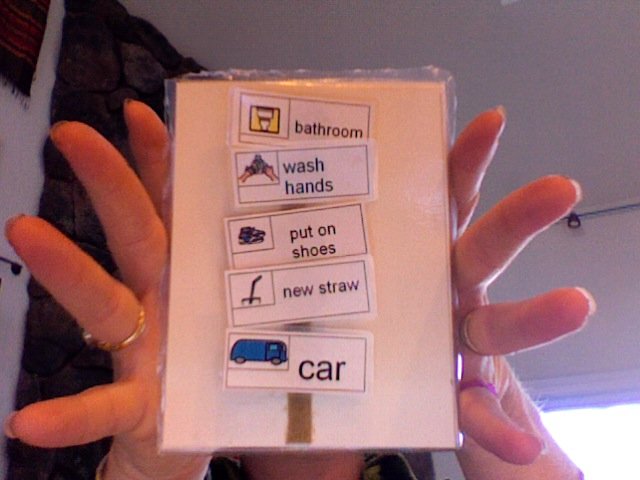
Visual schedules and visual charts are a great way to teach your child what events are to come as well as what activities or behaviors you would like to see from them.

Visual schedules are often used for children diagnosed with ASD (Autism Spectrum Disorder) as they are often times, concise, clear and the visuals aid in a child's comprehension.

In this way you can use visual cues to help support a child who struggles with behaviors.  Having a visual support to demonstrate the behaviors you WANT your child to exhibit helps remind him/her what behaviors he/she should be exhibiting in various situations. This technique is called using a visual chart or behavior chart.

Visual cues can also help your child understand time concepts.  By creating a daily, weekly or monthly schedule you can really help your child begin to understand days of the week, months of the year, and other time concepts. 

Once your child understands that each day is different, and time is not only measured on a clock or watch but can be measured in terms of "yesterday, today, tomorrow", you can begin to introduce various verb tenses.

The use of visual charts and schedules can also aid in reducing anxiety of the unknown by visually showing him/her what is coming up next.  If you have a child like mine, who has become obsessed with questions like "Mom, what are we doing today?" or "Mom, what's going on?", a visual schedule can be another way for your child to answer these questions for him/herself.  You begin to teach your children how to use what we SLPs like to call "compensatory strategies" to understand his/her world around him!

Tips to creating visual schedules:
1.  Keep it simple
2.  Know what you are trying to achieve or teach
3.  Use pictures that carry the meaning you intend


Example:  Weekly Schedule
In an effort to teach my child that everyday of the week has a name and we have plans for every day of the week, I made this very simple 7-day visual schedule below.  I have a symbol (and name) for every day of the week.  Below each day I have the typical activity we have planned for that day and below that I have a blank box.  I use this box to draw or write in any changes to our plans or additional activities we have planned for that particular day (I laminated the schedule so I could use dry erase markers on to do this).

Everyday my son moves a magnet from "yesterday" to "today"!  And we talk about what we did "yesterday" and what the plan is for "today" AND "tomorrow".  This is the beginning of introducing these time concepts.  We also address the day by its name as well so we begin to learn the days of the week.  (See how these activities lend itself to be a language activity as well???)

This is just one example of a visual schedule.  Your child's needs may differ from this.  Your child may be ready for a more complex visual schedule.  The key is to keep your goal in mind and create a schedule in which its complexity does NOT go beyond what your child can understand. 

Here are some other examples of visual schedules:


Courtesy of: squidalicious.com
This appears to be a visual schedule for morning routine.
It's short and simple!

http://www.programs4asd.com.au/visualaids.htm
This appears to be a visual chart used with smiley faces used to demonstrate that the behavior was complete.  I added this example to show that sometimes children need to do something to show completion of each step!


Courtesy of: alsc.ala.org
This is a simple horizontal visual schedule of events during what
appears to be a class period or therapy session of some sort.  A simple way to show your child the activity was completed is to have your child pull each picture off the schedule as it is finished.  I added this picture because I LOVE horizontal visual schedules as they mirror reading left to right and it is quite simple to find the next activity if you pull each picture off when completed.

Courtesy of: cecreality101.org
This is a simple visual behavior checklist.  I added this because it
illustrates how you can use visuals not only to sequence events or explain dates but to illustrate and teach your child what behaviors you want them to exhibit!
DIY-Visual Schedules:
You can make visual schedules fairly easy in this day and age of technology!

1.  Don't be afraid to use Real Pictures:  take pictures of your child performing the actions you want him/her to do, print them out, and put them in the correct sequence.  Real pictures are actually preferred for children that are more literal and struggle to understand symbols!

2.  Use Pictures found on Google Images or Bing Images:  You don't need a fancy computer program to create great visual pictures. You can find several great real life or cartoon pictures on these search sites that you can use.  Just remember to pick pictures that carry the intended meaning!

3.  Use tables, calendars and other templates in Microsoft:  One of the simpliest ways to create a visual table or graphic organizer is to use ones that already exist!  Why reinvent the wheel if all you need is a simple table that can be easily inserted into a Microsoft word document or powerpoint (that can be more easily manipulated in some instances)?! 

4.  Review the visual schedule with your child and spend time teaching him/her how to use it!  You cannot expect your child to understand or use a visual schedule just by seeing it once.  Visual schedules must be taught, referred to throughout the day, and rehearsed.  Don't expect your child to be able to use it independently overnight, although your long term goal is always to have your child use his/her visual schedule as independently as possible!

You can do it!  It just take time! 

I'd love to hear from parents and professionals on this topic.  If you have created and used visual schedules or visual behavior charts with your own children or your students or clients, what was the visual schedule for?  How did you teach your child how to use it?

As always...Happy Talking!!!
Related Posts Plugin for WordPress, Blogger...