Showing posts with label middle school. Show all posts

Tuesday, November 3, 2015

Accidental Learning!


What in the world is accidental learning?  Well this is a term I like to use for the learning that occurs during play and highly motivating activities.  As I just recently wrote a two part series on incidental teaching, I thought I'd also tackle one of my favorite types of learning that occurs naturally and without much planning.

Accidental learning is just that, it's unplanned.  It occurs spontaneously, most often in play and more often than not as a response to the interest of a student/client.  It happens when I am NOT currently targeting that particular skill, but with a simple model I can see it will benefit the student at hand.  Accidental learning may occur at any time and in any place.  Often times, I must illustrate to parents how they have fostered accidental learning as they feel they are only teaching their child in a structured environment.  Yet, learning is a way of life.  It occurs away from the desks and tables and out of sight of the chalkboards or dry erase boards.

So here are some of my favorite ways to facilitate some "accidental learning":

1.  Grocery Store Shopping:  The produce aisle is one of my FAVORITE places to facilitate accidental learning.  You can talk about so many great cognitive concepts such as colors, shapes, sizes, vegetables vs. fruits, counting and one to one correspondence, number identification on price tags, etc.  So many great concepts can be introduced and over time learned!

2.  Playground:  How great is the playground for accidental learning?  Our children can learn social skills such as taking turns, waiting our turn, waiting in lines (climbing up and down slides), introducing self and asking to join in play, etc.  When watching children play, we can see they are learning how to play cooperatively, follow each other's leads and directions, develop pretend play skills, etc.  Oh what a wonderful place the playground is!  Be sure to help your students or own children if you know they struggle with social skills.  Actually teach them the things to say in real time so they have a memory on which to base the use of particular social skills.

3.  Library:  Oh my goodness, what a TREASURE the public library is!  So many libraries now have children's rooms with developmental toys as well as puppets and books.  They offer great free programs such as story times, STEM educational events, puzzles, writing contests, super hero days, free movies (of which you can always find a book version within the library somewhere), etc.  Some libraries offer free tutoring, e-readers, access to other technology.  Don't discount your library!  You can find information on thousands of topics for your students and own children.  With simple book reading and re-reading your child's vocabulary can grow exponentially!

4.  Busy Bags and Waiting Rooms:  How often do we ask our children to wait?!  In doctors offices, post office lines, restaurants, in traffic, etc.  Sometimes our days are just spent waiting to complete the next errand.  So why not use this time for some great accidental learning?  Have you seen the busy bags ideas that are all over the internet?  If you haven't, here is a link to my pinterest board with several of these great ideas some brilliant mothers and professionals have created.  There are numerous ways to address early cognitive concepts as well as fine motor skills, sensory needs, language concepts, etc.  So MUCH accidental learning can take place simply by making some of these busy bags with objects around your house (and head on over to the dollar store near you b/c you will find some great items to use)!

5.  Family Reading Time:  I know a fellow teacher who has "reading parties" with her own children.  It's a great way to share a book together and is a wonderful way to learn new vocabulary,  learn how to retell a story, and also see how much your children are understanding of what they are hearing by simply asking them questions.  Depending on your children's ages, you can have them either write or draw a synopsis of the book after chapters or at the end of each book.  It's a great way to prepare you children for book reports that will eventually be coming at school!  It is a great activity that can easily be modified to use for middle and high school speech therapy sessions as well for our students who are really struggling with reading comprehension.  What a great way to use academic curriculum!

6.  Pretend play:  Pretend play with your students or own children is a MUST!  What great learning occurs here!  Skills such as communication, social skills, development of narratives, cooperative play, problem solving, etc. will easily develop with little help.  Simply have fun and you will see the learning without much help from you!!!!

Ok, so there you have it!  These are my six (b/c five was too few) favorite ways to facilitate accidental learning!  Feel free to share with parents as you counsel them or find ways to incorporate some of these activities with simple modifications into your therapy sessions.

Do you have a favorite way to facilitate "accidental learning"?  If so, please share below!


Happy Talking!



Tuesday, October 20, 2015

Replacing Undesirable Behaviors


When consulting with a mother of a child with Down Syndrome, she confided that she struggles with a very undesirable behavior the child exhibits.  He tends to scream at the top of his lungs in quiet places.  Therefore, taking her son to places such as the local library, her church, a restaurant or even a grocery store can be a very difficult trip for her.  I introduced her to the idea of replacing the undesirable behavior with something more socially appropriate.  But how do we do this?

Here are my basic rules when attempting to replace an undesirable behavior:

1.  Find a behavior the child can already do.  When replacing an undesirable behavior with something more socially appropriate, we do not want to spend time on trying to TEACH a new behavior if we have a perfectly acceptable behavior in something the child can already do.

For example, when I worked in the school setting, I had several PK students who wanted to climb on, hug or cuddle with teachers.  Although a hug here and there is necessary and a great way to boost our little ones confidences, we must remember that there are certain times when this behavior just isn't acceptable.  Circle time just doesn't work if everyone in the PK classroom wants to sit in the teacher's lap.  So we attempted to replace this behavior with a quick "compliment and high five".  This way each child was given individualized attention. The teacher or myself told each student something we really liked about their behavior that day (e.x. "Johnny, I really loved how you helped clean up the books earlier!") and they still received some physical contact with a "high five" before they were asked to sit on the floor.  We began with something the students could do without spending valuable time teaching a new behavior.


2.  Find something that motivates the child.  Again, remember your goal is just to eliminate the undesirable behavior as quickly as possible.  So to do this, we must find something that is MORE motivating than the current behavior.  If this replacement behavior is NOT more motivating, than it will NOT stick!  So really watch your students, know what makes them tick, and see what puts that light of excitement into their eyes.

For the little child with Down Syndrome above, he delighted in hearing his voice echo in quiet places.  He also enjoyed the attention his mother gave him after each scream when she looked at him and told him "sh" or "no".  So I noticed that he could use a pincer grasp to hold on to items AND he liked cool sounds.  Therefore, I suggested his mother get him a quiet book with LOTs of pictures to pull from velcro patches.  Each time he pulled a picture off the velcro, she was to give him quiet praise to feed his desire for parental attention.  The fun velcro sound would still delight him, while it was much quieter than his screams.  In addition, simple books such at these never run out of fun because you can simply return all the pictures to their velcro patches and he can begin again.

3.  Practice before "game day".  We know practice makes perfect but we are not trying to be perfect here.  We are just trying to replace a undesirable behavior with something a bit more socially acceptable.  As a child ages we can shape these behaviors into the "desired" behavior, the ultimate goal.  Yet in the meantime, an acceptable behavior will do.  But we cannot expect our children to be ready to substitute these behaviors if we do not practice them.  Practice your replacement behavior when is it not needed and your student will know how to perform them when it is.

For our little guy, practicing his quiet book at home for a few minutes a day, helps prepare him for his next library trip.

4.  You may need an external motivator.  Remember when working with cognitively delayed children you may realize, during your practice sessions, that the replacement behavior is NOT motivating enough.  However, if you couple that replacement behavior with an external motivator (E.x. Your student pulls all pictures off the velcro patches of a quite book then receives one goldfish as a snack), you may have a very compliant student on your hands.

5.  Over time fade out external motivators and/or find new replacement behaviors that are closer to desired behavior.  Over time you can begin to fade out your external motivator by providing them less often and inconsistently.  You can also spend time creating a repertoire of various socially appropriate replacement behaviors to keep interest and motivation high.  In addition, you can think about ways to shape these replacement behaviors to get the child to exhibit behavior closer and closer to the ultimately desired behavior.

For example, with our little guy who loves to scream, once we replace the screaming with quiet books and possible snacks, we may want to shape this behavior to using the quiet book independently in his own chair, rather than while being held by mom.  We may eventually want to practice using these replacement behavior for longer and longer periods of time at the local library, church or restaurant.  See how long we can extend the use of the replacement behaviors before the child looses attention or motivation.  The longer we extend the behaviors and the more we increase the independence with which a child uses the replacement behavior, the closer we will come to the desired behavior.

So these are my basic rules for replacement behaviors.  Remember it may take some trial and error before you find that one thing your student enjoys doing enough to replace an undesirable behavior.  But when you do, know you have struck gold. Run with it and soon you will be seeing a whole new side of your students.

Have you spent time replacing behaviors in the past? Feel free to share your experiences below to help others.

Happy Talking!
post signature

Monday, September 28, 2015

Middle School: Materials and Motivators Linky Party


Click on this picture to go to the first blog post in this link up!


The Frenzied SLPs FB page has been at it this summer, updating the way we are able to provide some educational and professional information by sharing tips, tricks, techniques, ideas and materials via bimonthly linky parties.  Now that things are beginning to settle down this fall, I'm finally participating in my first one.

Today I'm going to share with you some of my previously offered materials that could be used for middle schoolers.  Keep in mind, these materials are for students of varying cognitive and communication levels.  Don't miss out on these, most of these are freebies!  Click on the title of each material and it will take you to the blog link for that material.

Middle School Materials:


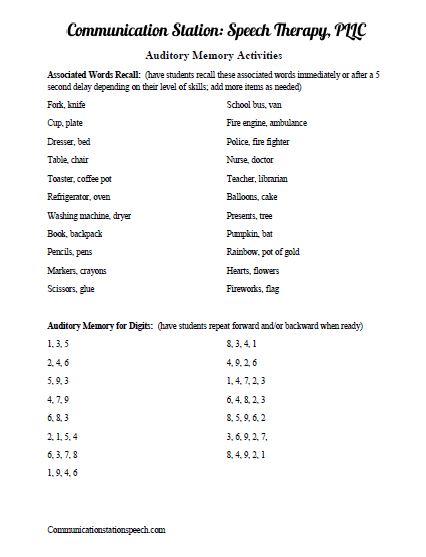
1.  Auditory Memory: Associated Words and Digit Recall Sheet


These are a just a few of the freebies you can find at my website (communicationstationspeech.com) as well as this blog address (communicationstationspeechtx.blogspot.com).  Click under the FREEBIE Friday labels on the right on both pages and you'll find a treasure trove of goodies!

My best advice for working with middle schoolers and keeping them motivated is to do two very simple things:

1.  Keep it fun.
2.  Follow their interest.

You do that and you should be just fine!  Check out all the other great blog posts on this topic from our fabulous SLPs participating in this link up.

Happy Talking!
post signature


Related Posts Plugin for WordPress, Blogger...