Tuesday, April 30, 2013

Tip Tuesday! Son-Rise vs. ABA for chidren with Autism?

Today I'll be talking about the differences between the Son-Rise program and ABA (applied behavioral analysis).

I placed this blog as part of my April ASD series here AFTER introducing one aspect of applied behavior analysis known as DTT (discrete trial training) and discussing Greenspan's DIR and Solomon's P.L.A.Y. project so that we have a foundation of the two "camps" of therapy out there possible for ASD children.

As you read on you will notice that the Son-Rise program is much more closely related to DIR and P.L.A.Y. project in the way they approach ASD as a social disorder as compared to Lovass's ABA therapy.

DISCLAIMER:  Just to disclose, I am NOT an expert in ABA or the Son-Rise program.  Nor and I going to address the research (and in some cases, lack there of) supporting or contradicting these programs.  If you are considering either option, I encourage you to explore all of your options and make the best decision based on research as well as your personal preferences.  I am NOT in favor of one program over another.  I am not soliciting either model nor am I being paid to support either of these programs or any models mentioned in any blog posts past or present.  I am simply sharing information so that you can become more knowledgeable about the possible therapy programs available for children with ASD and can make your own clinical and parental decisions re: how you want to move forward with your client/child.  

The following information was taken from a webinar series on Youtube by Ron Kaufmann, CEO of Son-Rise program. You can find part 1 of the webinar here.  For more information on the Son-Rise program go to Autism Treatment Center of America's website.

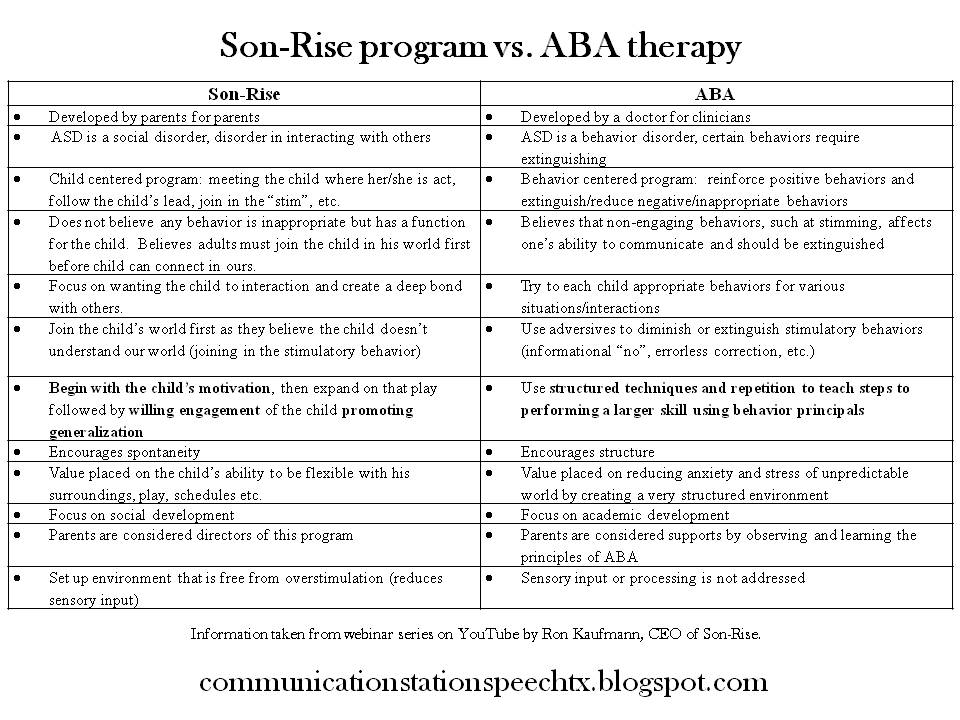
The following table has the main points I feel regarding the differences between these two programs.  As you can see, Son-Rise, like DIR and P.L.A.Y project, feel it is crucial to build social relationships and see ASD as a social disorder first and foremost and  feels it is imperative to train parents to use these techniques as well.  The one aspect that appears to be different is that the Son-Rise program appears to accept stimulatory behaviors and does not seem to address sensory processing issues in a traditional sense (i.e. sensory diet) as other models attempts to do.  At least that is how I understood Ron's information.  Unlike the P.L.A.Y. project, Son-Rise also appears to be more intensive than the recommended daily 2 hour home intervention, in 15-20 mins increments.  Again I am not an expert, this is just how I understood the information presented in the webinar series.

If you want to listen to them, feel free to click on the link above.


If you would like a copy of this table for your reference you can download it here.
I hope this series is providing you with a bit more information on additional theoretical models for treating children with ASD.  These are by NO MEANS a comprehensive list.  There are so many more models, techniques, and curriculum (e.g. TEACCH, SCERTS, Hanen, Carol Gray's Social stories, Michelle Garcia Winner's Social Thinking, Maurice curriculum, etc. just to name a few) one can explore for their child with ASD.  So if any of these are not what you are looking for or have not worked for your child don't get discouraged because as I believe with all my heart, there is no "one size fits all" approach.  Keep exploring your options and find the fit for your child!

Good luck and join us next month as we begin our series on the nonverbal child, a discussion that will continue through ASHA's Better Speech and Hearing Month of May!

Happy Talking!

Friday, April 26, 2013

FREEBIE Friday: Springtime Step-Sequencing Pencils!

I saw these cute spring colored pencils from Creative Clips clip art and immediately thought of a sequencing activity I could make for my kiddos.  Many of my young language delayed children struggle with retelling stories so I begin by teaching them ways to "sequence" everyday activities into 3 steps (modeling a beginning, middle and end of a story).  I made this activity in the same manner.  Because I work with mostly younger kiddos, it helps that we draw each step (I let them "draw" their version...and I draw a picture next to it to illustrate the step), and we put the 3 steps together to create a "visual story" to go along with these fill in the blank pencils.  For older kiddos who can visualize these steps already this is probably not necessary.  So use this activity in whatever way will work for you!

I left a blank space on each pencil in case you wanted your students to add an additional step on their own.

The other thing you can do with this activity is read the steps and have the students guess what activity you are describing.

Note: Congratulations to DGuenther and Cortney M. on winning a free eBook copy of Angie Voss' Understanding Your Child's Sensory Signals from last Freebie Friday's giveaway!  Thank you to all who participated!


Grab this freebie here!


Enjoy and Happy Talking!


Wednesday, April 24, 2013

Wild Wednesday! ASD: Follow Their Lead!

Following a child's lead may just the be BEST thing we as SLPs can do for your students with ASD.  As previously read in the post I shared about Dr. Greenspan's DIR and Dr. Solomon's P.L.A.Y. Project, following a child's lead is one of the fundamental principles of both  programs.  So if I've already talked about it why am I posting this again?  Because I want to make it very very clear HOW IMPORTANT this technique is with your students with ASD.

What does it really mean to follow a child's lead?  

Well the way I interpret this is to do what the child is doing!  That's pretty simple right?  Now how exactly do I do this?  Here are my 3 simple steps:

1.)  Have 2 of everything:  I personally begin by laying out a box of toys in the middle of the room (taking away all other visual distractions as best as I can) and I let the student take control.  In the box I have several different types of toys and I make sure I have 2 of everything.  

2.)  Monkey See, Monkey Do:  When my client picks up one of the toys I pick up its twin and I play with it the same way he/she is playing with it.  If my client is sitting on his knees pushing his forehead against a squishy ball on the floor, then so am I while simply saying "squish".  If my client is dropping his echo microphone on the ground and laughing at the sound, then so am I, while simply saying "bang".

3.)  Create a VERBal Routine:  When a child enjoys an activity, he/she will do it over and over again and so will I while saying that same one word utterance over and over (creating a routine).  After some time I begin to hesitate before producing that one word with the expectancy that the child will vocalize it.  If the child doesn't, no big deal, I just model the word again and again until he/she does.

As you can tell, most of these one word utterances will be verbs (a description of what we are actually doing with the object).  I find that verbal kiddos with ASD learn fairly quickly that objects have labels but struggle with understanding verbs.  This way they begin to understand verbs because we attach them to the actions we are exhibiting.

Always look for more while raising the bar!

As the child beings to play with more toys and say more words, I expand upon those utterances and look for things such as spontaneous productions, eye contact, facial referencing, emotions matched with correct facial expressions, typical prosody and intonation in play (less robotic or flat), initiation of play or conversation and participation in reciprocal, parallel, cooperative, and even collaborative play.

I know what you are asking yourself.  Can you really see all these skills just by following a child's lead?  YES!  All of these skills AND more!

Here's a personal example:
I began working with a primarily nonverbal PK age child that would later be diagnosed with ASD.  I initially "reached" him using some DTT principles as no other technique worked at the time.  But I found very quickly (within the first few months) that for him, his responses were very robotic and were not generalizing to other environments.  So I began play therapy with the focus on following his lead.  Within 4 weeks, this child went from 0 spontaneous utterances during a therapy session to consistently over 20 spontaneous utterances.  And these utterances were used for various communicative purposes: commenting, informing, greeting, describing, showing, gaining attention...etc.  His prosody and intonation were more dynamic carrying appropriate emotion and pitch changes.  In addition, his parents began to report noticing more talking within the child's home environment, demonstrating generalization (when we never even focused on using these skills outside of therapy at that point!).

So does this technique work?  YES it very well can.  It may not work for every child or it may work at different periods of development for a child but yes, yes, yes, it does work.

 And THAT is why I needed to write this post...because it really is so so important to FOLLOW A CHILD'S LEAD!

Happy Talking!

Tuesday, April 23, 2013

Tip Tuesday! DIR/Floortime, P.L.A.Y. Project: What's it all about?

Chevron boarder:  http://coffeekidsandcompulsivelists.blogspot.com.au/
Today I'd like to explore two other therapeutic models for working with children with ASD:  Greenspan's DIR model and Dr. Solomon's P.L.A.Y. project.

Disclaimer:  Please understand I am not an expert in either of these models but am attempting to simply share what I have learned via my own research for the sake of educational purposes ONLY.  I am not supporting one model over another, nor am I attempting to solicit any of these models.  I am not addressing research supporting or contradicting any of these models, those previously mentioned or those mentioned in future posts.  I am simply sharing information.  If you are looking for more specific information, specific research, or for a certified clinician in DIR's Floortime or P.L.A.Y Project please go to these links.

Keep in mind what you are reading today is FUNDAMENTALLY and THEORETICALLY DIFFERENT FROM APPLIED BEHAVIORAL ANALYSIS (ABA).  They are two very different theoretical camps in which these programs are based so if you read about DTT a few weeks ago, keep in mind this is COMPLETELY different, AND STILL VERY IMPORTANT FOR US TO KNOW AND USE AS APPROPRIATE!!!


Ok enough disclaimers...let's get to the meat and potatoes!

There are several similarities between these two models as the P.L.A.Y. project was created with Dr. Greenspan's input but Dr. Solomon takes it a step further as you will see.


DIR/Floortime: (Dr. Stanley Greenspan)
So first let's talk about DIR which stands for Developmental Individual Differences and Relationship model.  As you can probably see from its name, DIR focuses on the child with ASD as an individual FIRST.  Here are some core principles of DIR:

1.  DIR is a model for comprehensively evaluating and treating a child with ASD by building: "healthy foundations for social, emotional, and intellectual capacities rather than focusing on skills and isolated behaviors"(website).  

2.  Developmental: we must understand where the child is developmentally as compared to Greenspans 6 levels of developmental milestones.

  • Stage 1: Self Regulation and Interest in the World
    • How is the child understanding and interact with his world via his senses?
    • How can the child calm and self-regulation?
  • Stage 2: Engagement and Falling in Love
    • Following your child's lead no matter what his interest are.
    • Dr. Greenspan believes these interests are a window into how your child feels emotionally and how he sees the world intellectually.
    • you assume that whatever behavior your child is displaying is for a purpose and are providing him some type of pleasure.
    • Once you've met your child where he is, you can begin to pull him into your world via interaction.
  • Stage 3: Two-Way Communication
    • Opening and Closing Circles of Communication
    • Child opens circle by showing his intention/interest.
    • You build on the intentionality by giving the child what he wants or responding effectively.
    • Child closes the circle by taking what you give him
  • Stage 4: Expanding Circles of Communication To Solve Problems
    • As the child masters two way communication he can open and close more and more circles thus expanding his language development along with social communication
  • Stage 5: Creating Emotional Ideas
    • Child develops ideas via play and learns to expand upon those ideas using more words and symbolic play
    • He learns to maintain ideas and use them to meet his needs/wants
  • Stage 6:  Emotional and Logical Thinking
    • A child can express a wide range of emotions and can connect various ideas in play
    • Child begins to understand concepts of space and time
    • Begins to become fully verbal
3.  Individual:  ways each child individually responds and regulates their emotions and senses with the world around them; child may exhibit various auditory processing issues, sensory reactivity (sensory integration issues), or even motor sequencing issues (possible apraxia?).  This particular area will address these individual differences by use of various EBP (evidence based practices) for these issues.


4.  Relationships:  this program sees ASD as a "social disorder" so its a disorder in one's ability to create effective relationships.  This part of the program focuses on improving the relationships of the child's communication partners by training them to follow the child's lead and expand upon the two way communication, etc.

There is so much more to say about this model but not nearly enough space or time.  So I recommend you check out Dr. Stanley Greenspan's DIR model and particularly his explanation of developmental stages AND ideas for ways to target those stages with your children.  Good, good stuff to follow a child's lead!!!


Update 4/26/13:  I received an email from Nancy Greenspan today who wanted to make a few things clear.  As I am not an expert on either model I feel it is important to use Nancy's words as they were shared with me.  Nancy writes:


"...I just want to let you know that although there may be differences between the two (I am not an expert on the Play Project)  both include home visits and parental involvement. It is not a distinction between them. Stanley wrote numerous book for parents so they could do floortime on their own. He recommended to parents that if they need help, they go to a trained professional or have one come to the home. His emphasis was on having parents be the main Floortimers. He felt that children would benefit most with this type of intervention. Hope this helps."

Nancy goes on to remind all professionals that:

"Our online courses on Floortime at www.StanleyGreenspan.com have just been approve by ASHA for CEUs starting May 1."

Thank you Nancy for sharing this information with us.  It will continue to guide professionals and parents when exploring and learning about various therapeutic models and various options for their children!
 
___________________________________________________________________________________________________________


P.L.A.Y. Project: (Dr. Rick Solomon)


P.L.A.Y. Project's Vision
“The vision of PLAY Project is to be a community-based, state-wide autism training and early intervention model dedicated to empowering parents and professionals to implement our intensive developmental interventions for young children (15 month to 6 yrs. old) with autism spectrum disorders in the most cost effective and efficient way.” (webinars, found on website)

The following information was taken from the 4 free webinars found on P.L.A.Y. projects website.


This model has 6 values:

1.  It is family and child centered
2.  Interventions are often in the child's natural environment (his home)
3.  It is a Parent-Empowered Model
4.  It is Relationship-Based
5.  It is Playful and fun  "When you do what a child loves, he or she will love being with you."
6.  Addresses the core deficit:  Social Impairment


P.L.A.Y. is a developmental model and is also based on Greenspans 6 developmental stages (in this model they call it FDLs).  

P.L.A.Y. projects methods focus on teaching:
1.  Contingent, reciprocal, social interactions
2.  Follow the child's lead, interests and/or intent
3.  Shared social attention
4.  Joyful relating
5.  Simple and complex nonverbal gestures
6.  Long interactive sequences (e.g. 50+) "Circles of spontaneous verbal communication"
7.  Symbolic language related to affect
8.  Intact ego functions


What are HCs and how do they help?
P.L.A.Y project attempts to help children with ASD develop FDLs 1-6 (based on Greenspand's DIR) by "training the trainer", by training the child's parents.  This model has a P.L.A.Y. trained professional (called home consultants or HC) go into the child's home one 1/2 day a month to train the parents on ways to follow the child's lead and way to create and respond to these "circles" the child is initiating.  These professionals then ask parents to spend 2 hrs a day (in 15-20 min increments) to implement the skills and techniques they have learned.  Each time the P.L.A.Y. HC will take data on the child's current skills, continue to teach and model for the parents, take video and review that with parents, etc.  These home consultants go into a child's home for 1 year (approximately 20 visits with video reviews and monthly visits) to train the parents on these skills.

This program also provided workshops and trainings outside of the home for parents IN ADDITION to their home consultations.

How does one become a HC?
HCs are usually masters level professionals (SLPs, OTs, Md., etc.).  They participate in a 4 day training course and are ready to begin home visits.  From that point they are video taped and supervised for 1 year.

________________________________________________________________________________________________


So these are just two additional therapeutic models for children with ASD.  I LOVE so much that the focus is on the child's lead AND on building relationships.  I ALSO very much LOVE the idea of training parents as I truly believe parents are and can be their child's best communication partner. I have and continue to use principles of these models to help make connections and building relationships with my young clients with ASD!  In case you are wondering, there is research out that supports these developmental models with more to come according to Dr. Solomon.

I hope this gave you more information on a few other ways to reach and teach our students with ASD.

Stay tuned next week for the discussion of comparison between another therapeutic model, Son-Rise, vs. ABA.


Enjoy and happy talking!!! 


Resources:  appropriate resource links were placed within the blog post above.  Feel free to read more about each model by clicking on the links above!


Friday, April 19, 2013

FREEBIE Friday: GIVEAWAY and Sensory Tips for Children with SPD!

This month we are talking all about Autism Spectrum Disorders.  Many children on the Autism spectrum will exhibit sensory processing issues also known as sensory processing disorder (SPD).  Today I have a wonderful educational FREEBIE using information from Angie Voss' fabulous, newly updated book, Understanding Your Child’s Sensory Signals: Keep it real.  Keep it sensory.  Keep it simple.

This freebie contains just a few challenging behaviors a child with SPD may exhibit, explanations of why it seems to occur and what we as parents, teachers, therapists can do about it in the moment.


Grab your copy of this freebie here!

Wait there is MORE!  Do you like these tips?  How about getting your own copy of this book with 113 pages of various behaviors and sensory tips for FREE?  Enter the giveaway at the bottom of this blog to win your FREE copy of Angie's AWESOME BOOK!!!!


I LOVE this book SO SO SO MUCH and believe it is such a FANTASTIC resource Angie Voss, OTR is kind enough to GIVEAWAY 2 FREE ebook copies for you!

Let's Talk Speech-Language Pathology and I are working together to share this great opportunity with you.  So make sure you ENTER TO WIN below!!!

Winners will be announced next Friday! Good luck!


a Rafflecopter giveaway


Enjoy and happy talking!

post signature

Wednesday, April 17, 2013

Wild Wednesday! ASD: Sensory First!

I know I've talked about a sensory diet for our kiddos with ASD but I want to take this moment just to once again highlight why we as SLPs MUST be involved in understanding our clients' sensory needs.

EVERYTHING begins with sensory input.  ALL learning occurs only through our senses.  So if our child has sensory processing deficits, the learning that would naturally occur via that sense is either not happening or is being learned in a dysfunctional manner.

Although diagnosing and treating a sensory processing disorder is OUT of our scope of practice, we as SLPs MUST work collaboratively with OTs in understanding our child's sensory needs.  The OT is a very busy person and cannot always be available for every student so we MUST take the initiative to understand how we can offer possible sensory activities (under the guidance of the OT) to help our students regulate their emotions and behaviors.

"That's not my job!" you say?  Well I would have to challenge you to think a bit differently.  If we are attempting to elicit verbal production from a child who is unable to regulate his own behaviors due to sensory issues, we will never improve language until we address the sensory issues first!

"Well I have my box of fidgets, so I'm providing sensory input already."  The truth is your child may need more intense sensory input to self-regulate.  I've had many clients where playing with a squishy ball or fidget is NOT going to get their bodies regulated.  I've had them jump on trampolines, run around gyms, use a scooter to scoot down the hall to the therapy room, carry heavy books,  pull a heavy Tupperware container of rice down the hall on a scooter, perform pushing and pulling exercises, bounce on a big exercise ball, play on the playground, etc. all to reach that moment of equilibrium where their body was finally in sync.  And do you know what happened?  They started talking!!!!  Sometimes, it really is that simple!  (So if you've never co-treated with your OT, I recommend you do so and learn all about your child's sensory needs)

When do I attempt to provide sensory input to a child I'm working with?  Here are just some of the times I provide sensory input:

  • If the child's schedule was affected that day.  
  • If the child's has had a change in the home or school.
  • If the child appears to be anxious.
  • If the child seems non-responsive to me.
  • If the child is exhibiting more stimmulatory behaviors than typical.
  • If the child is typically very verbal but is very quiet that day.
  • If the child's progress has plateaued.

So the next time you are feeling stumped because your student with ASD does not seem to be progressing or seems completely oblivious to you, try providing some sensory input to the child and just see what happens.  You might just be surprised!!!

Happy Talking!

Tuesday, April 16, 2013

Tip Tuesday! Autism and a Sensory Diet!

Disclaimer:  I am an SLP, NOT an OT and not the specialist in the area of sensory processing.  I share this information below for the sole purpose of education as a very brief overview of this area of treatment for children with ASD.  If you would like more information on this subject, go to the SPD foundation website or contact an SI certified OT near you.

Sensory processing issues are a common characteristic of Autism Spectrum Disorders (ASD).

NOTE:  Throughout this blog post you will see a few flyers that address sensory issues in children written for parents and teachers as well as a teacher sensory processing checklist (please note their creators at the bottom of the pages).  These are screening tools one can use if they feel there may be a possible sensory processing issue.  If you believe your child has a sensory processing problem, please contact an OT experienced in sensory integration.

What is sensory processing?  Sensory processing (also known as sensory integration or SI) is how the central nervous system receives incoming stimuli from a person's senses and translates that information into appropriate behavioral and motor responses.

What is sensory processing disorder (SPD)?  Also known as sensory integration dysfunction; this  occurs when sensory signals do not get organized into the correct motor or behavioral responses.  A person with SPD finds it difficult to react appropriately to various sensory stimuli and these difficulties can affect ALL areas of development and all environments (information form SPD foundation website).


What is a sensory diet?  A sensory diet is the sensory "food" your child may need throughout his day in order to regulate his sensory system as well as improve his ability to process incoming stimuli via various senses.  A sensory diet is a carefully designed list of daily activities created by an occupational therapist certified or with experience in SI.  An evaluation of your child's sensory processing skills is conducted and from there, this list of individualized activities are created and based solely on your child's sensory needs.

Sensory diet activities tend to result in immediate change in behavior for a child as their sensory system is being "fed" the proper nutrients for the child's central nervous system!


The Hyper vs. Hypo-sensitive Child:

The hypersensitive child senses things at a much more intense level than you and I.  Therefore this child may attempt to escape activities that are too intense for him.  This child may avoid touch, textures, smells, noise, and visual stimuli (e.g. maybe the sun is too bright for this child and he requires the use of  sunglasses, or puts his hood up, etc.).  This child may response to light touches, soft tickles, quiet music, bland food with little taste/texture difference/smell, etc.

The hyposensitive child struggles to keep his body at the right level of awareness and tends to be a sensory seeker.  This child be described as having no fear and may enjoy rough and tumble play, deep pressure, LOTs of movement, etc. in order to regulate his sensory system.

What does an example of a sensory diet look like?  Head on over to Sensory Diet Activities website and scroll to the bottom of the page to check it out.

Remember this is an example only!  Sensory diets should be individualized and designed, reviewed and updated by an OT that specializes in SI.


As an SLP, I have worked with some wonderfully amazing SI OTs in the past and have even co-treated clients.  I can personally vouch for the importance of addressing a child's sensory processing.  I have had several clients who being to verbalize more during or immediately after sensory activities. I've had clients who could not attend jointly to a task prior to sensory activities that could sustain joint attention after.  I've had students in classrooms that could ONLY participate in large and small group activities after receiving proper sensory input.

Do not be duped into thinking this area is not as important or necessary as other areas in which you would like to see improvements (such as academics, communication, etc.), because ALL OTHER SKILLS BEGIN WITH PROPER SENSORY INPUT!!!!  Keeping that in mind, sensory activities have also been known to benefit children with numerous other diagnosis and disabilities as well!

Now you have a brief overview of what a sensory diet is and how it works.  Please understand that this is one of the most (if not the most) important aspects that MUST be addressed for children with ASD as we learn EVERYTHING via our senses.  If our sensory processing system is dysfunctional, our learning will also be affected.


As SLPs, what is our role in sensory processing issues?

Well I believe we have several rolls.

1.)  The first of which is the roll of observer:  we should be observing the child's behavior in various situations and how the behavior changes (improves or worsens) when various stimuli are presented or removed.  A good example would be that we as SLPs may notice in the lunchroom a child may REALLY struggle with sitting, eating, talking, or just being present in the room as compared to our speech therapy room.   Why is that?  Well maybe the noise level is too overwhelming; maybe in our speech room we have less visual distractions as well.  As an observer we can notice what environments are working best for our students and share that information with the OT and the rest of the multidisciplinary team so appropriate modifications and accommodations can be made.

2.)  Support Staff:  I believe a secondary roll we can play as SLPs because we see these children on our caseloads and have good rapport with them, is to be a supporting staff member to this child's sensory diet.  I have many times, had OTs train me as well as the classroom teacher, aides, special educator and paraprofessionals, on how to implement the child's sensory diet so we as staff members who see this child on a regular basis can make sure his sensory needs are being met as an adult with which the child feels comfortable.  I very much love this part as I immediately get to see the effects on spontaneous language production after a child receives the sensory input he is so desperately requiring.

3.)  Consultant/Collaborator:  I believe our third roll as SLPs is to be a consultant and collaborator with the student's OT.  Some sensory activities that previously worked may no longer do so and we as SLPs may be the only individual who is taking note of this information.  The OT must know if these activities are no longer working so the sensory diet may be updated and revised to fit the student's needs.


Do you have concerns about your child's sensory needs?  If so, please contact an SI OT in your area for a consultation.

Also I recommend you checking out A Sensory Life's website.  It's a FREE educational resource.  There are a TON of great resources and videos for parents and professionals!!!

Enjoy and happy talking!

Related Posts Plugin for WordPress, Blogger...