Showing posts with label Audiology. Show all posts

Friday, October 19, 2012

Spothlight on Audiology: (Central) Auditory Processing Disorder!


You may have heard of Central Auditory Processing Disorder (CAPD) or Auditory Processing Disorder (APD) in the past.  These terms are used interchangeably and refer to the same skill set.

The following information was adapted from the ASHA website  (American-Speech-Language Hearing Association).
Please click on the link above for more detailed information.


What is (Central) Auditory Processing [(C)AP]? 
ASHA's (The American-Speech and Language Association) definition: “(Central) Auditory Processing [(C)AP] refers to the efficiency and effectiveness by which the central nervous system (CNS) utilizes auditory information”. 
AP includes skills such as:
·         “sound localization and lateralization;
·         auditory discrimination;
·         auditory pattern recognition;
·         temporal aspects of audition, including temporal integration, temporal discrimination (e.g., temporal gap detection), temporal ordering, and temporal masking;
·         auditory performance in competing acoustic signals (including dichotic listening); and auditory performance with degraded acoustic signals”

What is (Central) Auditory Processing Disorder [(C)APD]?

According to ASHA,(Central) Auditory Processing Disorder [(C)APD] refers to difficulties in the perceptual processing of auditory information in the CNS as demonstrated by poor performance in one or more of the above skills”, and the cause of which cannot be attributed to deficits or delays in cognition, language, attention skills or other disorders (e.g. Autism, learning disability, etc).  With that said, APD can at times coexist with other disorders but is NOT the result of the coexisting disorder.

In other words “(C)APD is best viewed as a deficit in the neural processing of auditory stimuli that may coexist with, but is not the result of, dysfunction in other modalities”.

Although skills such as phonological awareness, auditory memory (including attention skills to auditory information presented), auditory comprehension, auditory synthesis, and other similar skills may be reliant on the auditory process, they are considered higher level cognitive-communication skills or language-related functions and are not included in the definition of (C)AP.

How does APD affect my child’s development?

Although (C)APD affects individuals differently, school-age children can demonstration difficulties in a number of areas:
·         learning difficulties
·         speech production deficits
·         language deficits (comprehension and expression)
·         reading delays
·         writing deficits
·         behavioral, emotional and social difficulties

(C)APD Screening:

·         Can be conducted by audiologists, SLPs, psychologists, and others using a variety of measures that evaluate auditory-related skills
·         Screenings usually consist of:  observation of listening behavior,  performance on tests of auditory function, questionnaires, checklists, and other related measures that look at auditory behaviors related to academic achievement, listening skills, and communication.
·         At this time there is no universally used method of screening and screenings should not be used as diagnostic tools.

(C)APD Evaluation: (Due to the inconsistency of language, cognitive and auditory skill development in young children, it is believed that children below the age of 7 cannot be effectively diagnosed with (C)APD.  In fact some professionals believe that diagnosis cannot be consistent or effective prior to the age of 10 years; the age at which the Central Auditory System is considered fully developed.)

·         Can only be conducted by an audiologist familiar and experienced in this area of specialty
·         ASHA’s code of ethics discusses 13 principles to APD testing:

1. the audiologist should have the knowledge, training, and skills necessary to do testing.
2. The test battery process should be motivated by the referring complaint and the relevant
information available to the audiologist.
3. Tests used should have good reliability and validity
4. A central auditory test battery should include measures that examine different central processes.
5. Tests generally should include both nonverbal (e.g., tones, clicks, and complex wave-forms) and
verbal stimuli
6. The audiologist should be sensitive to attributes of the individual.
7. the audiologist needs to determine the appropriate tests for each individual.
8. The audiologist should be sensitive to the influences of mental age on test outcomes. When testing
children below the mental age of 7 years, task difficulty and performance variability render
questionable results on behavioral tests of central auditory function.
9. Test methods should be consistent with the procedures defined in the original research of the test or
as specified in the test manual or literature.
10. The duration of the test session should be appropriate to the person's attention, motivation,
and energy level, and should permit the measurement of a variety of key auditory processes.
11. SLPs, psychologists, educators, and other professionals should collaborate in the
assessment of auditory processing disorders, particularly in cases in which there is evidence of
speech and/or language deficits, learning difficulties, or other disorders. The speech-language
pathology assessment provides measures of speech and language ability and communicative function,
and assists in the differential diagnosis of an auditory processing disorder.
12. In cases in which there is suspicion of speech or language impairment, or intellectual, psychological,
or other deficits, referral to the appropriate professional(s) should be made. In some cases, this
referral  should precede (C)AP testing to ensure accurate interpretation of central auditory
results.
13. Test results should be viewed as one part of a multifaceted evaluation of the individual's
complaints and symptoms. Examples of other data that should be examined include but are not limited to
systematic observation of the individual in daily life activities, self-assessments, and formal and informal
assessments conducted by other professionals.

Types of tests available for (C)APD:

The types of testing measures available for assessing APD are listed below.  This is not an inclusive list, meaning that an APD assessment is NOT required to include testing types, but  is just a guide for clinicians to understand the types of testing available for (C)APD assessment. (list directly quoted from ASHA website)
1.      Auditory discrimination tests: assess the ability to differentiate similar acoustic stimuli that differ in frequency, intensity, and/or temporal parameters (e.g., difference limens for frequency, intensity, and duration; psychophysical tuning curves; phoneme discrimination).
2.      Auditory temporal processing and patterning tests: assess the ability to analyze acoustic events over time (e.g., sequencing and patterns, gap detection, fusion discrimination, integration, forward and backward masking).
3.      Dichotic speech tests: assess the ability to separate (i.e., binaural separation) or integrate (i.e., binaural integration) disparate auditory stimuli presented to each ear simultaneously (e.g., dichotic CVs, digits, words, sentences).
4.      Monaural low-redundancy speech tests: assess recognition of degraded speech stimuli presented to one ear at a time (e.g., filtered, time-altered, intensity-altered [e.g., performance-intensity PI-PB functions]), speech-in-noise or speech-in-competition).
5.      Binaural interaction tests: assess binaural (i.e., diotic) processes dependent on intensity or time differences of acoustic stimuli (e.g., masking level difference, localization, lateralization, fused-image tracking).
6.      Electroacoustic measures: recordings of acoustic signals from within the ear canal that are generated spontaneously or in response to acoustic stimuli (e.g., OAEs, acoustic reflex thresholds, acoustic reflex decay).
7.      Electrophysiologic measures: recordings of electrical potentials that reflect synchronous activity generated by the CNS in response to a wide variety of acoustic events (e.g., ABR, middle latency response, 40 Hz response, steady-state evoked potentials, frequency following response, cortical event-related potentials [P1, N1, P2, P300], mismatch negativity, topographical mapping). The use of electrophysiologic measures may be particularly useful in cases in which behavioral procedures are not feasible (e.g., infants and very young children), when there is suspicion of frank neurologic disorder, when a confirmation of behavioral findings is needed, or when behavioral findings are inconclusive.”

The SLPs role in (C)APD:

ASHA’s Scope of Practice in Speech-Language Pathology statement explains the SLP’s role in (C)APD should focus on “collaborating in the assessment of (central) auditory processing disorders and providing intervention where there is evidence of speech, language, and/or other cognitive-communication disorders”.

Treatment of (C)APD:

ASHA describes three main types of treatments for (C)APD:

1.       Direct Skills Remediation or Auditory Training:  this treatment approach is designed to resolve or reduce (C)APD.  Direct remidiation should be deficit specific, intense and frequent (often requiring daily sessions for several weeks), and adequately challenging (between 30-70% accuracy; 70% accuracy MUST be met before increasing difficulty of taks).  Auditory training tasks should require active participation and provide immediate feedback and reinforcement to maximize learning.  Auditory training activities include (not limited to):
a.       Activities targeting intensity, frequency and duration discrimination
b.      Phoneme discrimination
c.       Phoneme-to-grapheme skills
d.      Temporal gap discrimination
e.       Temporal ordering or sequencing
f.       Pattern recongnition
g.       Localization/lateralization of sound
h.      Recognition of auditory information presented with competing background noise

For a number of specific FREE auditory training activities go to Bonnie Terry Learning

2.      Compensatory strategies training: treatment approach designed to minimize the impact of residual (C)APD unable to be resolved via auditory training and that affects or exacerbates deficits in language, cognitive and academic areas.  Strategies themselves are not effective in remediating the effects of (C)APD but should be practiced often and in various communication environments as one with (C)APD will most likely require the use of these strategies over his/her lifetime to be successful.  There are 2 main types of strategies.
a.       Metalinguistic strategies:  include
                                                              i.      Schema inducation and discourse cohesion devices
                                                            ii.      Context-derived vocabulary building activities (e.g. pre and post-teach academic vocab)
                                                          iii.      Phonological awareness skills (e.g. letter/sound ID, rhyming, decoding, encoding, segmenting/blending of sounds/syllables)
                                                          iv.      Semantic network expansion activities (e.g. synonyms, antonyms, homonyms, categories)
b.      Metacognitive strategies:
                                                              i.      Self-instruction
                                                            ii.      Cognitive problem solving
                                                          iii.      Assertiveness training (also focus on improving self-reliance and self-efficacy)

3.    Environmental modifications: goal is to improve presentation of information at class, work or other communication environments.  Strategies  focus on enhancement of the signal and listening environment.  The following is a list of more common strategies used but this list is far from comprehensive.
a.       Preferential seating (means close to the point on instruction)
b.      Use of visual aids
c.       Reduction of competing signals and reverberation of acoustic sounds
d.      Use of assistive listening systems   (Note:  The strongest indicators for the use of personal FM as a management strategy are deficits on monaural low redundancy speech and dichotic speech tasks which  involve degraded signals, figure-ground, or competing speech that are similar to the effects of noise and reverberation)
e.       Have other speakers present auditory information slowly, pause more often, and emphasize key words

You can find a more complete list of classroom accommodations and modifications below:
Accommodations and Modifications for the Classroom

What should you do if you suspect your child has (C)APD?
Contact an experienced audiologist in your area for a consultation.

If you are an audiologist or an SLP who is well-versed in (C)APD, feel free to comment below.

Happy Talking! 


Thursday, October 18, 2012

Spotlight on Audiology: Auditory Verbal Therapy (AVT)

 The following blog could NOT have been possible without the guidance, education, and assistance of Lynn A. Wood, M. A., CCC-A, LSLS Cert. AVT  of Auditory Verbal Center of Wheaton.  She is a wonderful resource and wealth of informtion.  Please find her complete biography at the bottom of this blog.   

Auditory Verbal Therapy (AVT) is a great way to faciliate spoken language and close the gap in learning, language, and cognitive skills for children with hearing loss and their same-aged peers.  Trained and certified audiologists, speech-language pathologists, and/or educators can provide AVT.

Why choose AVT rather than Sign Language or other alternative modes of communication?  The below information was provided by Lynn A. Wood of the Auditory Verbal Center of Wheaton.

There is a great shift towards listening and spoken language for children who are deaf and hard of hearing.  Approximately 95% of children with hearing loss are born into hearing and speaking families;  they are interested in having their child communicate through spoken language.

Because of  universal newborn screening programs, advanced hearing technology (sophisticated hearing aids and cochlear implants) and family-centered therapy, most children who are hearing impaired, can communicate through spoken language, use clear speech, are academically and socially at comparable level as their hearing peers.

NEVER BEFORE IN HISTORY OF THE EDUCATION OF THE DEAF HAVE THESE CHILDREN HAD SUCH HEARING POTENTIAL.

A diagnosis of hearing loss/deafness does not need to mean a lifetime of silence and lost opportunities in spoken communication.  With today’s hearing technology, children with hearing loss and/or auditory neuropathy spectrum disorders have the opportunity to hear, listen and use spoken language. 

Warren Estabrooks, M.Ed., Dip.Ed.Deaf, LSLS Cert. AVT, writes,

"Most of these children are learning to listen to their own voices, listen to the voices of others and listen to all the other sounds of life. By learning to listen, they are learning to talk. By learning to listen and talk, they are learning to communicate in spoken conversations. By learning to listen and talk they are learning to read and write. By learning to listen and talk, they are achieving the dreams of an abundant academic and social life held for them by their parents. "

  Carol Flexer, PhD, CCC-A; LSLS Cert. AVT, professor of Audiology at The University of Akron, Akron, Ohio writes,
"...current research confirms several facts for families who desire a spoken language outcome for today’s infant or toddler who experiences hearing loss. Families need to know that very early use of hearing aids or insertion of a cochlear implant for severe to profound degrees of hearing loss to access, stimulate, and grow auditory centers of the brain during times of critical neuroplasticity – followed by thoughtful, intense, and ongoing auditory exposure and enrichment activities to take advantage of developmental synchrony and cumulative practice – offer a high probability of reaching their desired outcome of age-appropriate spoken language and literacy skills".
So, what is AVT?

The following information was adapted from a presentation titled Children with Hearing Loss: Context for Evaluating Auditory-Verbal Effectiveness, from the ASHA website. I encourage you to click on the link above and read the information for yourself.

Auditory Verbal Therapy (AVT) is:
A sytematic treatment plan for children with hearing loss that focuses on:
  • Early Detection of hearing loss with the use of the most optimal hearing technology at the earliest age possible
  • Hearing is NOT about sound but about BRAIN development of auditory cortex
  • Focus is on parent-based listening and talking activities all day long (e.g. “parent coaching strategies” to train skills to teach their own children how to listen and talk)
  • AVT is seen as a way of life...NOT just a therapy program
A very important part of AVT is the family’s lifelong VISION for their child. The AVT professional guides and coaches the family in obtaining their ultimate outcome which simply stated is for their child to listen and talk.

Research supporting AVT:
  • Research indicates potential for children with hearing loss to use AVT successfully (Durieux-Smith, et al., 1998; Dornan, et al., 2007; Goldberg & Flexer, 2001; Eriks-Brophy, 2004)
  • Other research suggests an acclerated rate of learning for hearing impaired children with the use of AVT (Duncan, 1999; Duncan and Rochecouste, 1999; Hogan, et al.,2008).
  • According to two studies by Rhoades, compared to a control group, children whose hearing loss was detected early, and appropriate technology and AVT were used, there was no significant difference in the rate of progress between the two groups after 50 months of treatment...suggesting that with the effective early intervention, the gap in learning, language and cognitive skills can be closed!!!! (Rhoades, 2001; Rhoades & Chisolm, 2000)
What is a Auditory Verbal Listening and Spoken Language Specialist?
"LSLS professionals help children who are deaf or hard of hearing develop spoken language and literacy primarily through listening" by focusing on "education, guidance, advocacy, family support and the rigorous application of techniques, strategies and procedures that promote optimal acquisition of spoken language through listening by newborns, infants, toddlers and children who are deaf or hard of hearing."In addition, "LSLS professionals guide families in helping their children develop spoken language through listening and coach them in advocating their children’s inclusion in the mainstream school."
Professionals certified in Listening and Spoken Language Services (LSLS) adhere to AVT principles and practices. To find out more about AVT LSLS certification go to: AG Bell Academy for Listening and Spoken Language

With such great research and information out there on early detection and hearing technology, we as SLPs would be remiss if we did not learn about this area of special and work cooperatively with AVT certified specialists in order to most effectively treat our clients.

Happy Listening and Talking!!!


Special thanks to the collaboration and education of Lynn A. Wood, M.A., CCC-A, LSLS Cert. AVT of which this blog could not have been possible to complete.  Ms. Wood is an Audiologist, a Listening and Spoken Language Specialist and a Certified Auditory-Verbal Therapist who has worked with individuals with hearing loss and their families for over 30 years. Her private practice specializes in pediatric Auditory-Verbal therapy, post cochlear implant rehabilitation for children and adults and therapy for individuals with auditory processing disorder. Prior to opening the Auditory-Verbal Center of Wheaton in 1987, she worked in a variety of medical settings as a Clinical and Rehabilitative Audiologist, an Auditory-Verbal therapist and was the Director of Audiology at Akron General Medical Center in Ohio. She served for many years on the Certification Council of Auditory-Verbal International (AVI) and as a Child’s Rights Advocate for the Alexander Graham Bell Association for the Deaf and Hard of Hearing. She was a faculty member and served as a mentor at 2009 and 2010 Children's Memorial's Medical Center’s Auditory-Verbal Institute Summer Programs and is a co-founder of Hearing Connections, a group for Auditory-Verbal families and friends in Chicagoland. In addition, Ms. Wood volunteers and serves in the GEMS (God's Exceptional Masterpieces) special needs ministry at Wheaton Bible Church in Illinois.

Wednesday, October 17, 2012

Spotlight on Audiology: How to read an Audiogram and Typmpannogram!


Audiogram:
An audiogram is a graph display of one's hearing threshold (i.e. the lowest volume one can here at various pitches or frequencies).  Volume is measured in decibles (dB) and pitch is measured in hertz (Hz).  X is the symbol for left ear measurements and O is the symbol for right
ear measurements.
When given an air or bone conduction test, your child is presented sounds at various frequencies (beginning at 125 Hz through 8000 Hz) beginning at 0dB and increasing volume increments until an affirmative response is made indicating hearing threshold for that particular frquency.
Typical conversation is measured around 45dB.  However, if your child's audiogram measures affirmative response at 0 dB, this means that your child is accurately responding to that particular frequency at the softest possible level at least 50% of the time.
Severity of Hearing Loss:
If a child presents with affirmative responses 20 dB or below for all frequencies (pitches), their hearing acuity is judged to be typical as compared to same-aged peers.  Hearing thresholds between 20-40 dB is considered Mild hearing loss; 40-55 dB is judged to be a Moderate hearing loss; 55-70 dB is labeled as Moderately-Severe hearing loss; 70-90 dB is considered Severe hearing loss, and any hearing thresholds found to be greater than 90dB is judged to be a profound hearing loss.
Three Types of Hearing Loss:
There are three types of hearing loss:  conductive, sensorineural and mixed (a combination of conductive and sensorineural).  Conductive hearing loss occurs in the outer and middle ear and often times can be remediated via simple measures.  Sensorineural hearing loss occurs in the inner ear and may or may not be able to be resloved via surgery.  One can have a mixed hearing loss which is a combination of both conductive and sensorineural hearing loss. 

Readingy a Tympannogram:
A tympannogram is used to measure the fluidity of movement of the typmannic membrane (i.e. ear drum) and middle ear bones. 

A typical response indicates adequate movement of the typmanic membrane (ear drum) and ossiclation of middle ear bones.
A hyperflaccid response inidicates more typmannic membrane movement than necessary affecting hearing acuity.
A stiff ear response indicates less movement than needed for typmanic membrane and middle ear bones.  Most common causes of this would be ear infections, however there are other less familiar causes as well.
This is a very simplistic description of tympannogram responses.  As I am not an audiologist, I will leave the more indepth discussions up to the professionals.  Just understand that any atypical response can affect hearing.  Causes and possible treatments should be discussed with a licensed audiologist!
If you are concerned with your child's hearing or question weather he/she is hearing accurately, don't hesitate to contact a nearby licensed audiologist for a consultation!
Happy Talking and Hearing!!!

Tuesday, October 16, 2012

Spotlight on Audiology: Hearing Tests!


We all remember the school nurse taking us to her office, placing headphones on our ears and asking us to raise our left or right hand when we hear a "beep" in the respective ear.  But we didn't know that was just scraping the tip of service in this wonderful science called "Audiology".

Audiologist perfrom testing to determine if one's hearing, balance or processing skills are compromised.  Today we will talk about the art of diagnosing hearing loss.


Newborn Hearing Screenings:

Before the hospital will release your newborn, a hearing professional (may or may not be an audiologist) will perform a newborn hearing screeing on your child.  If your child is born at home, a hearing screeing should be done within the first 2 weeks of life.  The goal is to identify any babies that are "at risk" for hearing loss as quickly as possible.  If your baby is "referred" at a newborn hearing screening you MUST follow up with an audiologist to determine IF a hearing loss is present and if so what type of hearing loss your child has.


Tympanometry:
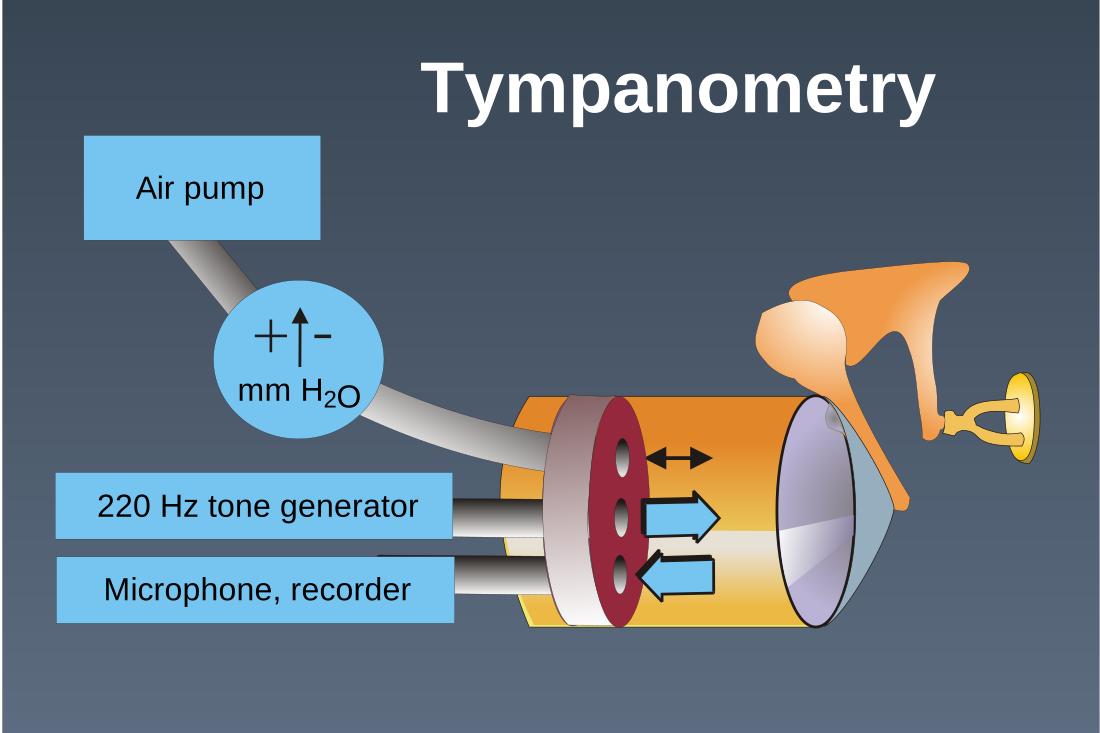
This tympanometer is used to test the movement of one's ear drum and the 3 small bones in the middle ear.  This can be done on babies, children and adults.  The rubber tip is placed in the ear canal and a tone is played.  This device measures the rate with which this tone bounces off the ear drum (also known as tympanic membrane) attemtping to measure if there is adequate movement and vibration of the tone through the outer and middle ear. Causes that could result in lack of movement: wax build-up or fluid in the middle ear (otherwise known as an ear infection). Difficulty with middle ear movement is called "conductive hearing loss" and can often times be remediated via PE tube placement (for excess and chronic fluid) or simple other measures.


Otoacoustic Emissions Testing (OAEs):
When a sound is played in the inner ear, a different sound actually results demonstrating that the "ear is listening".  The OAE is like the tympanometer in that you place rubber tip into the ear and play a tone, but the OAE is measuring the inner ear tone (rather than movement/vibration of the middle ear) to determine if the inner ear is coding sound appropriately.  The OAE is not as exact as more involved testing measures but for children this is a good indicator that the inner ear is probably functioning in a typical manner. 


Auditory Brain Response (ABR): 
Electrodes are placed on the forhead and behind a child's ears. A speaker is placed in the child's ear.  The speaker emits clicking sounds at various loudness levels and the electrodes are there to measure the electricity of the nerve responses to the clicking sounds giving the audiologist an indication of how loud a sound must be before the child's brain actually responds to it.  Hearing loss measured by this test is called "sensorineural hearing loss" and may or may not be able to be fixed via surgery.

For reliable children and adults the following are the most common tests used:


Air Conduction testing (AC):
This is the type of hearing test most of us think of.  An audiologist will have an child (old enough to follow directions) or an adult sit in a sound proof booth and present various tones at various loudness levels and the child/adult must indicate when they hear the sound.  This test results in an audiogram which is a diagram and one's hearing threshold at various frquencies (pitch) and decibles (loudness levels).


Bone Conduction testing (BC):
This test is similar to the air conduction test however the device is placed on the mastoid bone (behind one's hear) and the adult/child will still indicate if they "hear" the sounds presented.  An audiologist can compare the AC and BC testing results to help differentially diagnose between a conductive or sensorineural hearing loss.

 For more information, please contact an audiologist near you!
Stay tuned for tomorrow's installment of our audiology blog-fest focusing on how to read an audiogram and tympanogram!

To find out more about reading Audiograms or Tympanograms click here.

To learn the basics about what Audiology is, click here.

Happy Talking!!!
Related Posts Plugin for WordPress, Blogger...