Showing posts with label Tip Tuesday. Show all posts

Tuesday, October 1, 2013

GIVEAWAY!!!!


Are you looking for your TIP TUESDAY blog post??? Well guess what?!  I'm having a GIVEAWAY on my new blog website!  Click here to head on over and enter today!!!! 

Winner will be announce in this week's Freebie Friday blog post (10/4) so enter today.

I hope you win!!!! 

post signature

Tuesday, September 24, 2013

Tip Tuesday: Using Big Block Singsong in speech therapy!

Photo Credit
I've been thinking about blogging about this topic for a while now as it is just a fun therapy activity you can do with your young kiddos.  Have you ever watched the "Big Block Singsong" shorts that play on a few of the children's channels or on youtube?  

These shorts are colorful, fun, engaging animations that are only a few minutes long.  Each short consists of a song that teaches young children about various age-appropriate topics.  Depending on your student's cognitive level and language skills, I could see these animated clips being used for children PK-early elementary ages.  You can find these cute "big" blocks singing about:


Photo Credit
  • animals
  • body parts and senses
  • being brave and trying new foods
  • coping with feelings of anger
  • other emotions such as happy and sad
  • concepts of same vs. different
  • fruits vs. vegetables (and healthy foods)
  • occupations (magician, farmer, etc.)
  • and so much more

How do I use Big Block Singsong for therapy?


1.  First, I introduce the topic/theme
2.  Then we watch the big block singsong animation that goes along with that theme
3.  We talk about what we learned from big block singsong
4.  Replay the clip and sing along (repetition) 

Want to check it out for yourself?  Here is a link to one of my personal favorite episodes on youtube:   http://www.youtube.com/watch?v=TrwxTedNwCQ 

The clips can be used to teach so many skills:

  • categories (animals-farm/ocean/forest, foods-fruits/vegetables)
  • time concepts (night/day)
  • concepts (same/different)
  • emotions (what they look like, what things might make us feel a certain way, how should be handle each emotion)
  • social skills (trying new foods, coping with anger, meeting/making new friends, being friends with someone who is different than I am, etc.)

Have you ever used "Big Block Singsong" in your therapy?  If so, how did you use it?  Do you have any tips for us?  Comment below!

Enjoy and happy singing and learning!!!

post signature

Tuesday, September 17, 2013

Little Saint's PK: Alphabet Fun!

Alphabet Fun was the my son's home PK theme the past two weeks (with Labor day in there and taking a long weekend away this past weekend, it took us two weeks to do all the fun activities that went with our theme).

Here is a picture of some of the fun books we read about letters!  My son is HUGE fan of the Alphabet Adventure/Mystery/Rescue books by Audrey and Bruce Wood (I purchased these via Scholastic books last year but you can get them on amazon as well if you are interested).  I TOO love them! These books are great b/c they target the lower case alphabet (which I LOVE as most of the letters we write/type are actually lower case) in a fun adventurous story line for children.  So if you are looking for some new alphabet books, I recommend checking these out!

In our book bin this week we has some older books as well.  All were super fun to read and re-read!

One thing I like to do with my son is read each book first, then re-read it and we discuss what sound each letter makes and think of words or find pictures of in each book that begin with that sound.  Finally, we spent some time tracing the capital and lower case letters in the book "Eating the Alphabet" by Lois Ehlert.  Isn't that little chubby hand so cute?!  I love my son's little fingers!!!


We of course read our daily scripture (for those of you who missed my first installment of this PK program you can read all about it here) and discussed the lesson emphasis each day.  The emphasis was basically that we speak in words and words are made up of letters.  Some other fun activities we did were: 

Name letter sequencing:


As you can see I wrote each letter of my son's name on a fish card and he used his name tag to put the letters in the correct sequence.  He was a proud by when he was finished! :)

Chicka Chicka Boom, Boom! and art project:


The letters are climbing up the coconut tree!  We talked about each letter and the sound it made as he stuck each sticker on the "tree"!


My son tried very hard to cut out the coconuts along the circular line!  Great practice for fine motor skills!


We added our palm tree leaves and voila'...our coconut tree is complete!


Alphabet Soup:  


We made some alphabet soup simply by scooping up each letter and matching it to the correct letter in the bowl.


B/c we are incorporating religion at home, we made alphabet soup for the family and God, Mary, and Jesus.  


Add some veggies and a spoon and we've got ourselves some alphabet soup! Almost good enough to eat!

By the way, after we were done with our alphabet soup we spent some time playing rhyming games with these names.  Remember the name game song?  Well that's what we did!  "Mommy, mommy, bo, bommy, banana, fanana, fo, fommy, fe, fi, fo, fommy, Mommy!"  Great for early literacy skills!

Our Names in HIS book:


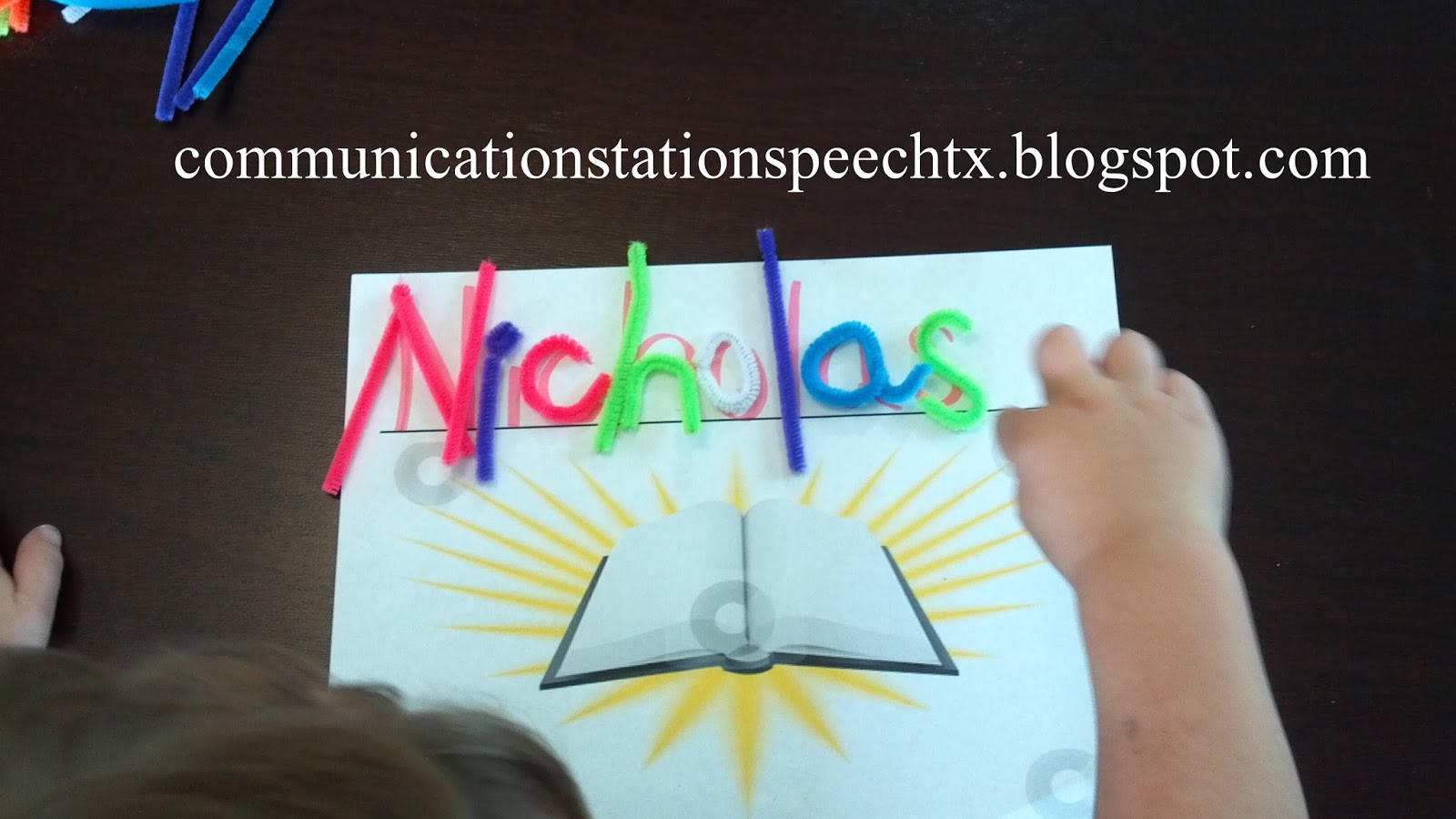
We talked about how God made each of us special and that our names are written in His book in heaven just waiting for use to come home.  I used some pipe cleaners to make each letter and my son had to match them up to his name!

Initial's fun: 


My son used glue and scrap paper to make his initials!  We had to discuss what initials actually were and how his looks different from mommy's and daddy's initials b/c our names are different.

Magnet letters and tracing:


This was a cool activity I saw somewhere before...maybe on Pinterest.  I can't exactly recall but it was NOT my original idea.  My son used some magnetic letters and a highlighter to spell out and trace our names! (p.s. the F letter was one of the extra letters he had to choose from a mix to spell his name.  He of course did not choose any letters that did no belong in his name but I didn't move it before I took this pic...oops!)

Sidebar:  Boy activity:


My boys worked hard repainting my son's train table first with magnetic pain, then with dry erase board paint so we can NOW draw, write, and stick magnets to the bottom of his train table.  Oh what fun we will be having in the future!  Well done boys!  the table looks great!!!


So that was our last two weeks in a nutshell.  You can see how language as well as phonemic and phonetic awareness was incorporated into almost every activity this week!  All of these activities are easily adapted for your own home practice or for speech therapy.  Next week I'll share with you the fun activities we are doing this week as we learn about our 5 senses!

Happy talking and learning!
post signature

Tuesday, September 10, 2013

Tip Tuesday: Halloween Themed Books You CAN Read in Schools!

Working in the public school system is always a challenge when it come to holidays.  As speech pathologists we want to talk about the appropriate vocabulary and culturally appropriate experiences children participate within their homes and communities.  However, in this day and age, political correctness (and in my humble opinion over sensitivity to these matters) many times ties our hands and we are stuck with discussing "fall harvest" rather than Halloween.  I don't know about you, but teaching my students with ASD how to knock on someone's door, and appropriately say "trick or treat" and "thank you" is so much more functional than talking about scarecrows and corn mazes.  I, of course, believe we need to respect others' beliefs, but I feel all of this can be balanced better in a more tolerable nature than what we current have.  With that said, I am one person and cannot change the laws or district policies out there for many of you.  BUT, I can try and give you an alternative way to discuss much of that same vocabulary via books that are "Halloween" themed without any mention of Halloween.  

So, here are my go to books when I cannot discuss "Halloween" but I still want my students to come away with real culturally appropriate vocabulary:


The Legend of Spookley the Square Pumpkin:  I LOVE this book for the fall season!  (You WILL see this again in October...hint, hint...there's a Freebie Friday post with Spookley's name on it) This book has a great moral message about accepting others even when they are different than us.  And of course a square pumpkin is super cute too!


The Little Old Lady Who Was Not Afraid of Anything:  Who doesn't love this book????  Oh the actions, sound words, repetition, sequencing activities that can be done just by reading this fun little book about a very brave old lady!


I Spy Pumpkins:  You know I love my "I Spy" books from my previous post (if you haven't read it, you can check that post out here).  This is no exception.  Looks creepy from the outside, but children with have lots of fun trying to spy some pumpkins in the midst of these "busy" pictures!


The Pumpkin Mystery:  This book is a great chapter book.  It's simple but discusses how we plant and harvest pumpkins disguised in a fun, kid-friendly "mystery".  Great for predicting and inferencing as well as for retelling, discussing main idea, etc.


Five Little Bats Flying in the Night:  This book is just like the 5 little Monkeys book but super fun for the fall!  These silly bats will keep young children entertained while incorporating language and math in one!


Where's My Mummy?: This a sweet book about a baby Mummy who's looking for his mama.  Of course you meet a few crazy characters (e.g. skeleton, vampire, etc.) along the way who teach us all about bedtime routine and in the end, our baby finds his mama!


Of course we can't forget Eric Carle's The Very Busy Spider!:  Last year I wrote a few posts about using a spider theme in therapy and creating a human spider web.  You can check them out here and here if you missed them!


The Spider and the Fly:  I also like to use this book (my picture did not come out well on my camera so I had to use a pic from amazon) for my older students.  It's actually a poem about a Spider who tricks a fly to come into his "parlor" and he of course eats her.  It is a bit dark, but my older students love to look at the illustrations and make predictions as to whether this fly will be fooled by the spider.  This book is also good for my students with ASD as the spider says he wants the fly to come in for one reason or another, but of course that is not true.  I like to teach my students to "listen to the spider's voice" (as I read it in a "creepy" voice) and see if they can really figure out why the spider wants the fly to come inside.  Sometimes it takes a while for our literal kiddos to really understand the true meaning of the spiders words.


Ok so that is my list of books you CAN read in the schools.  You CAN discuss some really great culturally relevant vocabulary while skirting around the idea of "Halloween" and still teach some great language skills!

What do you think of my list?  What are your favorite "Halloween" themed books you CAN read in school?  Share below so we may all benefit!

Enjoy and happy talking!

post signature

Tuesday, September 3, 2013

Tip Tuesday! Let's Talk About Voice Disorders!


The "terrible twos" and what I like to call "horrendous threes" seem to be that time when our children are trying to determine their role as an individual in our families.  Temper tantrums are part of everyday life.  So it is not unusual for us to hear crying, screaming and yelling in our homes at any given moment.  However, we must remember that prolonged use of such vocally abusive behaviors can cause our children to have voice disorders.


We as parents are so used to hearing our children screech out in excitement or cry out in frustration that we tend to forget that this type of vocal abuse can cause our children to have voice disorders. 
  
What is a Voice Disorder?
     A voice disorder is defined as an abnormality in at least one of the following:  vocal quality (resonance, e.g. nasal or hyponasal), vocal pitch, and vocal intensity (volume level).

What causes a voice disorder?
     A voice disorder can be caused by a number of things:
  • Vocal abuse over a period of time which caused growths on one's vocal cords (known as vocal nodules or polyps).
  • Vocal cord (also called vocal fold) movement difficulties due to
    • vocal fold paralysis,
    • spasmodic dysphonia (when vocal cord movement is tight, jerky, and there are vocal cord spasms with periods of aphonia-lack of voicing),
    • paradoxical vocal fold movement (when vocal cords close when they should be open).
  • Most child voice disorders are caused by vocal abuse so let's explore that further.

Vocal Abuse can be caused by numerous behaviors.  Here are some more common causes:
  • Excessive Screaming
  • Excessive Yelling/Shouting
  • Excessive Crying
  • Cheering (at sports events)
  • Singing
  • Chronic use of a higher pitch than typical
  • Chronic use of louder volume than typical
  • Chronic coughing due to colds
  • Chronic post-nasal drip due to allergies
  • Chronic medical illnesses that affect the throat area (ex. laryngitis, strep throat, etc.)
  • Inadequate breath support (not using diaphragmatic breathing)
What are the signs and symptoms of a voice disorder?
  • rough/hoarse voice
  • breathy voice
  • scratchy voice
  • harshness in vocal quality
  • decreased pitch and volume range
  • difficulty sustaining voice and difficulty singing
  • moments of aphonia (i.e. unable to achieve voice)
What should I do if I see these symptoms in my child?
  • Discuss your concerns with your pediatrician and contact an ENT (Ear, Nose and Throat doctor) or Otolaryngologist to determine if there is a medical reason for your child's vocal disturbances (structural damage vs. vocal cord movement problems)
  • Then contact a Speech-Language Pathologist so your child can participate in voice therapy.  **Keep in mind speech therapy will be MOST effective when the SLP knows the underlying cause (i.e. structural damage or other medical issues) and how your child's vocal cords are moving.  This can only be determined by the ENT/Otolaryngologist evaluation.**
What is voice therapy?
     Voice therapy consists of teaching your child the optimal ways of using their vocal quality (resonance), pitch and intensity (volume).  It focuses on reducing abusive behaviors, while improving healthy vocal cord behaviors (e.g. proper hydration, use of proper breath support, etc.).  Voice therapy has been found to be very effective in reducing voice disorders and improving vocal quality.

For further information on Voice Disorders go to American-Speech-Hearing and Language Association website.


If you are concerned about your child's voice, don't hesitate to contact a local Speech-Language Pathologist for a consultation.


Happy Talking!

Tuesday, August 27, 2013

Tip Tuesday! Thematic therapy and vocabulary!

I have been working with preschool age children with speech and language deficits for many years now and I have found, for me, the most effective way to improve language skills and receptive and expressive vocabulary is to do so using themes in my speech therapy!

If you look at a typical preschool program, they are modeled by following a weekly theme as well so it makes sense to me, that I would model my therapy for the same children in the same manner.  When I worked in the schools as an early childhood speech pathologist, I would obtain a list of classroom teachers' weekly themes for the whole year up front and build my therapy sessions around the child's weekly classroom themes.  The nice thing about this was that most of the early childhood teachers did follow the same weekly themes throughout the year so my therapy activities could be used for most of the children on my caseload regardless of what classroom the child was in.  Of course modifying the activities to focus on individual goals and highlighting individual strengths is a necessary component of any successful speech therapy session.  So keep that in mind when planning your thematic therapy.

As you know, I am a firm believer in play therapy as well, although I do believe there is a time and place for drilling an new skill prior to expecting carryover.  So setting my therapy schedule up to match the classroom teachers' themes actually allowed me to have more in-class therapy time (push-in therapy, inclusion therapy, whatever you want to call it) during their free play times in order to practice learned skills in a functional play setting with same-aged peers.  I found this to be very enjoyable as well as effective.  While in the classroom, I was able to observe what skills each child has generalized to the classroom setting and which skills required more work from me.

I also found that (what I call) the "speech hat" effect at times could be more of an illusion than true mastery.  The "speech hat" effect is what I call the phenomena when children seem to demonstrate success with a speech and/or language skill in the speech room with myself (as if they put on their "speech hat" at my door) but cannot carryover to other environments.  So getting a bird's eye view in the classroom really helped to guide my therapy goals and expectations accordingly.

Another reason, I very much love to create thematic therapy units is because it is a natural way to teach and increase awareness of categories which aids in semantic networking, word retrieval and of course language development.  If I'm focusing on zoo animals, then I will not be taking about a sheep or cow, but I will be discussing giraffes, lions, and tigers.  Now I've naturally created a scheme for zoo animals without having to actually spend time "teaching" the category.

So how did I create my thematic units?  What types of activities did I include?  Well, each week I planned and included at least one of each of the following activities below.  Not every child would participate in every activity as I would choose which activities best met their communication needs (I was always thinking "individualized therapy" and that was my guide to determining the best activities for each student on my caseload).  These activities are in no particular order and can be interchangeable.  I usually presented at least 2 different activities during our sessions as appropriate (which were only 20 minutes due to shorter attention span and also aided in keeping groups smaller which improved 1:1 attention).  However if spontaneous natural learning was occurring I would NOT change to another activity just because I had another one planned.  Therapy at this age is all about following the child's lead.

Here is a list of the types of activities I would plan for thematic therapy:

1.  Thematic Book:  I always chose a book about the weekly theme.  I tried to keep this book just above the current language skills (so I usually had 3 different levels of books for my lowest to highest kiddos and would choose books accordingly).  By the way, the school library (or media center, since that's what many are being called these days) is a great resource for thematic books of varying levels of complexity!

2.  Thematic Song:  I loved incorporating music with our weekly themes so I would teach my kiddos 1 or 2 new songs each week.  We added gross and fine motor movements which made it all the more fun.

I LOVE the Piggyback song book series and I use them even with my own son!!!  I know they are old but they are great!  These books are filled with wonderful kid songs to familiar tunes so you don't have to read music to learn new songs.  And where did I purchase these gems?  On Amazon of course! :)


3.  Craft/Art project:  This activity could be as simple as coloring or as complex as following multi-step directions to complete a craft.  A few time-saving tips:  I always cut up all the pieces to a craft ahead of time. I organized my glue, scissors, crayons, markers, paints and brushes in a small plastic tote for quick and easy use, and I always had child wipes on hand for those times we were enjoying a messy craft!  Wipes are a quick way to clean up kiddos that need to head back to class.

Back to School Countdown Craft Advent Calendar Using an Egg Carton from Lalymom
Since it is BTS time, here is just one example of a cute craft activity that can be used to incorporate language (following directions, vocabulary, spatial position words) and academics (shapes, numbers, etc.).  I found this craft on Twodaloo.  Click on this link for more BTS ideas. 

4.  Play activity:  There was always at least one play activity that incorporated fine or gross motor skills and thematic play.  Tip:  I always had the play activity as my second activity of the day, b/c it's easier to transition from playing back to the classroom, than from playing to another speech activity.  Here are just a few examples of play activities I have done in the past:

  • I had the fire trucks and doll house out the week we discussed fire safety
  • We played with my fisher price farm and animals when discussing farm animals week
  • We played with zoo animals and blocks to create zoo gates for each animal
  • We played with cars, trucks, planes, trains when talking about transportation week
  • We played restaurant with fake food the week we talked about our 5 senses (I would use real food to discuss concepts such as sweet, salty, sour, spicy, etc.)
  • We played with my band in a box (awesome for early phonological awareness skills, rhythm, tempo, pitch, etc.)  and sang many familiar children's songs during music week.

5.  Speech/language drill activity:  Sometimes, even with the above activities, I still needed to drill a skill in some way, so I would usually play a quick game (usually a reinforcer game that could be used with all goals) in order to drill the skill I was targeting that day.

6.  Academic skills:  I never made a separate activity for academic skills but I always incorporated academic skills into the above activities.  For example, I might ask a child to give me three zoo animals and see if he/she can show one to one correspondence when counting.  Or we might label colors of objects in play.  I also would see if children recognized their names by sitting where their name tag was.  Sometimes we made patterns when building with legos, etc.  The list can go on and on, but its very, very easy to support academic skills in speech therapy tasks even at a very young age.

When I first started using thematic units as a therapy guide I created my own table like the one below to keep me on track and organized.  Over time, I used the table less and less but in my mind I still organized my thematic therapy the same way.  So here is just a visual example for you:


As you can see, I love thematic therapy and thematic vocabulary!  I feel it's the most functional way to teach vocabulary and expand language for young children.

Here is a nice website, I shared on my FB page months ago that allows you to create your own thematic therapy schedule for the year. Check it out!

Enjoy and Happy Talking!!!
post signature

Tuesday, August 13, 2013

Tip Tuesday: Disney World Tips and Tricks for INSIDE the parks!

P

The following are tips and tricks we learned through trial and error once inside the Disney World parks.  As always, use what you think will work for you!  So here are my:
20 Tips and Tricks for INSIDE the Disney World Parks:

1.) Make a plan 1st thing you enter the park:  Upon entering the parks you will get a map and listing of entertainment and times for the events happening that day.  So look at the entertainment (parades, shows, character meet ups, etc.) and determine what you which of those you want to do first!

2.)  Plan your rides around your entertainment:  once you know what entertainment you want to go to, then plan the rides you definitely want to ride and plan your route!

3.) Pack snacks and lunch:  I cannot stress this ENOUGH.  Tons of time is wasted in lines trying to get food and drinks.  If you pack snacks, drinks, and lunch you will save $ and time!!!  Remember you can always go to a nice dinner in the evening if you want (but if you want to go to dinner, make sure you find out if you need to make reservations)!

4.)  Use stroller parking:  If you are bringing a stroller use the stroller parking that is provided for the rides and shows.  You WILL have to take your stroller BACK to stroller parking if you don't abide by these rules so do it right the first time and you will save time :)

5.)  Start early and go back and take a nap:  We got to the parks early (close to opening) and during the hottest part of the day, we went back to the hotel to take a nap and get refreshed.  So WORTH it!  My son took very LONG naps everyday and it really helped him stay away for the late festivities in the park!  If you have children you will be surprised how they can stay up so late IF they are given a good long nap!

6.)  Take advantage of extended park hours:  I do not recommend going to parks that open earlier b/c there are just TONS of people entering the parks early trying to make the most of they day but that will add time to waiting in lines, etc.  BUT I do recommend taking advantage of LATE/EXTENDED hours (ESPECIALLY in Magic Kingdom) b/c many families take their children home after the night parades or fireworks and you will have super short lines and get so much more done in just that 1 extended hour!!!!

7.)  Take advantage of lines shorter than 20 mins:  If you want to go on a ride and you see line wait time is 20 mins or shorter, GET IN LINE, b/c that is probably the shortest wait time it will have all day!

8.)  Arrive at shows 10 mins ahead of time:  the Disney parks do a great job keeping their arenas for shows large enough to accommodate large crowds.  I know they say show up 30 mins ahead of time before shows starts to ensure a seat, but we were there during one of the busiest months and we got into every show we wanted to go to by showing up 10 mins before the next show.  This will SAVE you at least 20 mins per show you go to, to use for other things (rides, etc.).  We went the three shows in Animal Kingdom and showed up 10 mins before for each (we saved ourselves 60 mins to do other things that day!!!!)

9.)  9 o'clock showing of Fantasmic (Disney Hollywood Studios):  This 9 o'clock show DOES get packed so you MUST show up 30 mins ahead of time OR go to the 10:30 pm showing which we LOVED b/c it was not packed at all!

10.)  Photo pass:  I know most people don't want to get the photo pass but we got one just to see if there were any pics we missed out on or didn't get a good pic that their photographers did get.  Ordering pics is pricey so be sure you really want that pic if you decide to order.  ALSO if your photo pass gets wet, you can go to customer service and get it transferred to a clean photo pass.

11.)  Large groups...DON'T be afraid to split up:  I know you want this trip to be a family thing but if you are going with a large group (our group was a group of 8 so that was large) DON'T be afraid to split up.  Let those that have the same interests go with each other and find places to meet up throughout the day!  It will make sure you all get to do what you want to do for the short time you are in the parks!

12.)  Remain patient and positive:  No matter how sticky and sweaty you are.  No matter how tired you are or how many blisters you have on your feet, try very hard to remain patient and positive...especially to the cast members.  They are just as hot and tired as you and they deal with that EVERYDAY!   Cast members really try to make Disney World the happiest place on earth so let's help them out!

13.)  Do not wait to buy souvenirs at Downtown Disney:  if you REALLY love a particular character or movie, make sure you take time to buy the souvenirs for those characters/movies in the themed gift shop they have in the parks.  Downtown Disney stores are good for general souvenirs but they can't possibly carry everything so if you really LOVE a souvenir, get it in the parks when you see it!

14.)  Charge your phones and cameras nightly:  Make sure every morning your phones and cameras are fully charged.  And clear off the memory on your phones and cameras each night (by downloading onto a hard drive/computer) so you have maximum memory for the next day!

15.)  Use the Disney App:  if your phone will allow it, use the Disney app so you can find out where characters were going to be, what lines are shortest, and where fast passes are still available!

16.)  Scavenger Hunts in parks:  Every park has some sort of scavenger hunt daily for kids (and even adults if you so choose to participate).  We LOVE scavengar hunts but didn't have enough time to do it.  However, we saw a number of children really enjoying themselves while doing these hunts (particularly in Epcot the kids really seemed to love it!)

17.) Use FP (fast pass):  You can use your FP every 2 hours!  So get into the parks and FP the rides you definitely want to go on!  Also we were traveling with a few people who were NOT going to go on any FP rides so we were able to use their FPs for other rides without having to wait 2 hours.  I'm sure this is probably NOT supported or recommended by Disney but it worked for us! :)

18.)  Autograph books:  If you want to save money, bring a booklet from home to get autographs.  But if you want the whole Disney experience, I would recommend you buy your autograph book ASAP when you get into your 1st park b/c you never know when you will meet a character!!!

19.)  Use easy WDW:  this website is great b/c it gives you an awesome calendar of what parks are recommended to be the best park to attend each day, which parks have extended hours, how large the crowds are planned to be, weather for each day and so much more!!!  It's a great website to help guide your experience and vacation plans!  We used it and it really helped! :)

20.)  What to do in the parks:

Epcot:  Epcot if geared more for older children and adults.  If you have young children you may not plan for much time to be there at all.  

  • Fast pass Soarin' in the am b/c the fast passes do run out!
  • Enjoy the shows in the countries if you can!
  • Fast pass Test Track
  • In each country there is a kid's craft/activity they can partake in so don't miss it if you think the kids will enjoy it!
Animal Kingdom:
  • Go to see the Lion King show!  It's awesome!
  • Go to see Finding Nemo: The Musical!  Great for all ages
  • Fast pass the Safari so you can save time
  • Definitely spend time meeting the characters here b/c the lines are SO MUCH SHORTER!
  • If you have young kids, plan to spend some time in Dino Land play place b/c it will keep them entertained and allow them to burn off energy.  There is only one entrance and exit so it keeps children safe as well. 

Disney Hollywood Studios:

  • Do go to the stunt show!  It only shows 2xs a day but its so cool!  And my 3 year old loved it so it's great for kids as well!!!
  • Do get pics with Lightning McQueen and Mater!  They were next to the Muppets theater when we were there and boy was it exciting to see the kids get to touch Lightning and Mater!!!!
  • Go the the Honey I Shrunk the Kids play place early as it closes early!
  • Go on the back lot tour early...its really neat to see how some Hollywood magic is made! (it also closes early)  If you have kids, bring snacks b/c even if it isn't that interesting to the kids, they will enjoy the snacks!
  • Want to go to a character breakfast or lunch?  It was recommended to me to go in DHS b/c it is less chaotic as compared to MK.  
  • Fast pass Tower of Terror and Rock n' Roller Coaster!
Magic Kingdom:  
  • I do NOT recommend going to MK in the AM b/c there are like a million people there but if you have a park hopper, I do recommend going in the afternoon, after naps, while other children are napping and/or during dinner time b/c there is a smaller crowd.
  • The electric parade is done at 9 and 11 pm.  I recommend while everyone is sitting trying to watch the electrical parade at 9 pm, you get in line for some rides and enjoy the smaller crowds at the 11pm parade.  We LOVED watching the later parade, we could actually SEE it! :)  Also if you watch the electric parade from Frontier land you will have a great seat!!!
  • Definitely take advantage of extended hour in MK. We got on so many rides, in that 1 hour that we would have never been able to do had we not been there at that time!
  • Try to go on Pirates of Caribbean during 1st showing of electric parade b/c lines are SUPER short (we had no wait!)
  • When the crowds are really big (like they were when we went in June), we took advantage of the Disney Railroad to travel from "land" to "land" and it saved us so much time!!!  So you might want to check that out!
  • Fast pass Space Mountain and if you don't get to go on the Safari in AK, then Fast pass the Jungle Safari in Adventure land.  It will save time!
I hope you have enjoyed these two blogs and what we found to work for our family.  Has something else worked for you?  Feel free to share in the comments!!! :)

You can also find some great Disney tips on what used to be called Oh, How Pintearesting blog but is now All Y'all Need.  Just scroll down on the right and find her Disney tab, click and read all about her recommendations and suggestions!!!!


Happy Talking!!!


post signature

Tuesday, August 6, 2013

Tip Tuesday: Disney Tips and Tricks: What do know BEFORE you get into the Parks!


So as you know by now, my family and I spent a week in Orlando and enjoyed a wonderful vacation at Disney World at the end of June!  Of course we planned it during one of the busiest AND of course hottest most humid time of the year.  Hahaha!  But we learned a few tips and tricks I'd like to share with you!  

These are the things that worked for us (keep in mind we were traveling with a group of eight people including a 3 year old).  So use whatever works for you!


Tips and Tricks:  What to know BEFORE you get into the Parks!

1. ) Know your transportation:  we stayed at Shades of Green, a hotel on the Disney resort for military, vets and their families, and it took us a little bit of time to learn how the shuttles worked for each park.  

  • There were buses to and from the hotel to Animal Kingdom, Disney Hollywood Studios, and Downtown Disney (as well as the water parks Blizzard Beach and Typhoon Lagoon) which only arrived once hourly.  To get to Magic Kingdom and Epcot, our shuttles (every 20 mins) dropped us off at the Transportation and Ticket center where we took the monorail to each park.  It appeared that many surrounding resorts's shuttles did the same thing so...my recommendation is to find out the NIGHT before your first venture out as to what the transportation looks like and the times your shuttles, etc. will arrive and depart.
  • If you are planning on driving into Disney and parking in their lots be prepared to pay a fee (for this trip it would have been $15/day) so make sure you add that into your budget.

2.)  Make sure to pack a small first aid kit:  you never know what will happen on a trip so we like to make sure we have at the very least a few necessary supplies such as:

  • Band aids
  • Neosporan (great for making sure the small cuts and scrapes DO NOT turn into an infection)
  • Pain reliever (aspirin, ibprophen, etc. b/c you will have aids and pains from all the walking each day)
  • Moleskin (we like to buy it for all the blisters we end up getting...mostly me for some reason..hmmm)
  • Foot wraps or compression socks (if you have a history of ankle/foot injuries like myself you may benefit from wrapping your feet up each morning before you head out to the parks.  This really helped my feet reduce the swelling and foot pain I felt the first day at the parks.)
  • Any child medicine you may need (we always carry a thermometer and some child fever reducer and homeopathic cough and cold meds....just in case!  We haven't had to use it yet on trips but it gives me as mom a sense of security I guess.)


Photo Credit
3.) Stay Hydrated!:  I cannot STRESS this enough b/c I know if I was reading this I would probably not take this tip as seriously as it should be taken!!!  This time of year is SO humid in Florida and you will be sweating within mins of walking outside.  This time my husband had the brilliant idea of purchasing these Camelbacks for our trip!  Each morning he filled up our Camelbacks with hotel ice (as full as possible) then poured one bottle of water over the ice and we had almost 3 quarts of cold water a day (each) that we carried on our backs.  This was MUCH, MUCH lighter than I though it was going to be AND the fact that we had water readily available all day long kept us hydrated and cool!  The water stayed cold while we were outside and we refilled once we got back to the hotel before our event trek back to the parks. 

Best part about these Camelbacks?  ALL the extra storage space which we filled with snacks, lunch and other necessities!  Want to know what we packed in these pockets?  Keep reading!!!


4.)  Pack snacks, and lunch:  If you do not have a plan to eat lunch with any characters I HIGHLY recommend you pack lunch daily...not only will it save you money but more importantly (I think) it will save you TIME...precious, precious time you will need to take advantage of getting around the parks.  Yes you will have to go through bag check every time you enter a park BUT the amount of time you save compared to standing in line ordering lunch and finding a seat somewhere in the park to eat is significant!  PLUS if you are traveling with kids, you always need to have snacks and food readily available to ward off any meltdowns that can very easily occur.
  • What did we pack?  Granola and Special K bars, fruit cups, sandwiches (all of which stayed cool when in the pocket NEXT to the Camelback's bladder...perfect and no need for a separate cooler), fruit buddies (If you don't know what these are, they are applesauce of varying flavors that are stored in small plastic bags so children can suck out the applesauce and eat on the go), fruit snacks, AND lollipops (for those desperate moments right before my son totally melted down into a puddle of tears!).
  • We also packed sunscreen, band aids, Neosporan, bug spray, moleskin and ibprophen...just in case!  Yes ALL of these things fit in our Camelbacks without difficulty!


5.)  Wear a good pair of shoes:  This is extremely important! I saw a ton of people walking around in flip flops and by midday there were many who were slowly making their way through the park.  The problem is not all the walking as much as it is all the WAITING you will be doing in lines.  So I suggesting wearing a good pair of sneakers with good arch supports...ones that are broken in and won't give you blisters due to being new.  You can always pack flip flops for later in the day (which I did, b/c my feet HATE to be suffocated in shoes all day) but wearing sneakers really helped for the busiest parts of the day!


6.)  Wear sunscreen daily and use bug spray at night:  The sun is HOT in Florida.  It seems every time I go down there, I get sun poison on the same part of my body.  So this time, I lathered up on my sunscreen daily!  Bring hats to give you some shade!  And make sure you use bug spray at night b/c those mosquitoes are OUT at night time!!!


7.) Bring a fan spray bottle:  head on over to Walmart or where ever and buy yourself a fan spray bottle b/c you can get for 1/3rd the price it is selling for in the parks.  We brought our own fan spray bottles from home and it was a brilliant way to keep ourselves cooled off during the day!  (make sure your spray bottle has a lanyard so you can hang it on your neck, bags or, like us, the stroller)


8.) Bring ponchos with you in case of rain:  this time of year is hurricane season it can rain EVERY DAY if it so chooses.  And it may rain heavy for a bit but it will eventually stop so you don't want to miss out on a full day at the parks if you can wait out the storm and keep dry.  It costs $10 a pop for a poncho inside the park so you would be better off buying ponchos prior to entering the park and they are packed to neatly that they will add nothing to your bag of goodies!


9.)  Use ziplock bags:  put your personal identifications, park tickets, money, and all other important items in ziplock bags to protect them from water, sweat, humidity, etc.  Also carry several extras (of varying sizes) in your bags b/c you never know when you will need to use some ziplock bags!!! (Also great for storing wet clothes until you can get back to the hotel)


10.)  Bring at least 1 pen:  you will need a writing utensil for character autographs if you are getting them but if not you still may need a pen for notes, etc.  I like to use the pen to make off all the shows, rides, parades, etc. we did throughout the day on the park brochure so we could easily keep track of what we still wanted to accomplish before the day was through.


P
11.)  If you are bringing a stroller.... I recommend you use an umbrella stroller b/c its small and easy to maneuver.  IF you MUST bring a double stroller, I will tell you that the frontal seating strollers seem to be much easier to maneuver and fit better on buses and in stroller parking than the horizontal seating double strollers.  But that is up to you to decide what works best for your family.  I really liked our small umbrella stroller with a roof for shade but use what works for your family!  Now let's all agree on some ground rules shall we:
  • if you have a stroller...keep to the RIGHT!
  • if you are planning on stopping and checking on your child...stop on the RIGHT!
  • if you are walking slowing and taking in all the sights, sounds and smells...that's great, and make sure you do it while keeping to the RIGHT!
  • Do NOT cut off other groups that are walking just b/c you have a stroller!
  • Do NOT let your child drive the stroller around and bump into others.
  • If you or your child accidentally bump another person, APOLOGIZE!
These seem like logical social rules to me but I was shocked and surprised to see that the majority of stroller users are unaware or disregarded typical social rules so I felt I should state them here!

12.)  Transfer Paper Tickets to Plastic Cards Night Before:  there are a number of ways to get discounted tickets and I don't know all of them BUT what is important is if you do buy discounted tickets and they are paper tickets you MUST go to customer service to get them transferred to a plastic ticket (card) BEFORE you go into the parks.  We did not know this and spent an hour in line the first morning waiting to get these tickets transferred to the plastic entrance cards.  You can actually transfer your cards the night before you go to the parks as long as you go to customer service (which is at the entrance of all parks AND in Downtown Disney) and your card is NOT activated until you actually ENTER a park!  So that can definitely save you time!


These are my tips and tricks you need to know BEFORE you get into the parks.  Want to know what my tips are for INSIDE the parks?  Check out part 2 of this series next week!  

Has something else worked for you?  Feel free to share in the comments!!!!


You can also find some great Disney tips on what used to be called Oh, How Pintearesting blog but is now All Y'all Need.  Just scroll down on the right and find her Disney tab, click and read all about her recommendations and suggestions!!!!


Happy Talking!!!
post signature
Related Posts Plugin for WordPress, Blogger...