Showing posts with label Reviews. Show all posts

Tuesday, June 2, 2015

Tip Tuesday: Going Places (book review)


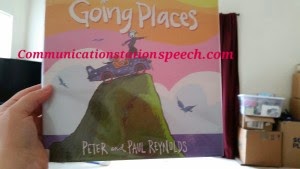
I found this book at our local library and read it to my son. I fell in love with it and found it to be a perfect book not just for my own child but also a great book for speech therapy for a number of reasons.

Firstly, the book is quite interesting for both boys and girls and it has great illustrations. But beyond the obvious I really like this book as a means to target social skills and higher level reasoning skills.


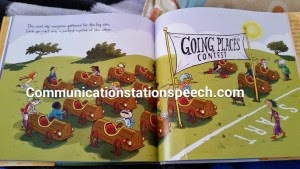
The book is about a boy who teams up with a classmate to make a special creation in order to enter into a race. The book encourages discussions about: teamwork, cooperation, compromise, personal inspiration, inventions and "outside of the box" thinking. The end of this book provides students with an opportunity to use context to predict what invention they will create next and through illustration only can a student determine if their "prediction" is correct. What a great way to work on predictions and inferences with our children with ASD!


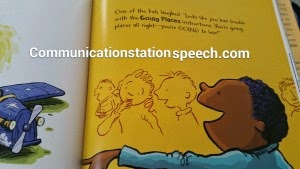
In addition, there is a moment when a fellow classmate criticizes the two main characters' creation. What a great opportunity to target social skills and talk about the ways in which we are different from each other and how we can accept others with our differences!

This is a simple book but one worth checking out at your local library.

Happy talking and reading!

post signature

Wednesday, March 20, 2013

Review: Behavioral Management Strategies for School-Based SLPs

Badge courtesy of:  http://coffeekidsandcompulsivelists.blogspot.com.au/
I don't often provide product reviews however, when I come across materials or educational information that I truly believe EVERY SLP can benefit from, I MUST share it!

As an SLP in the schools I have been certified year after year in CPI (Crisis Prevention Intervention) and have been part of behavior management teams.  I've taken data for FBAs (Functional Behavior Analysis) and participated in several BIPs (Behavior Intervention Program/Procedure) over the years, that I KNOW how important it is for SLPs to understand what behavior management is and how to effectively choose and use strategies for various students.

Why us?  Why SLPs?  In my opinion we as SLPs are so good at modifying the complexity of activities, accommodating for children with all disabilities and manipulating our environment to assist our students in being successful, that we are much more successful at understanding and identifying antecedents to behaviors in a way that other professionals do not get a chance to do in large groups (classroom teacher) or in one on one situations (such as other related services-PT, OT-provide).

So when Smart Speech Therapy's, Tatyana Elleseff, asked me to review one of her educational packets, I jumped at the chance to review her Behavioral Management Strategies for School Based SLPs packet.  Because I believe that EVERY SLP MUST UNDERSTAND BEHAVIOR MANAGEMENT AND KNOW HOW TO EFFECTIVELY USE VARIOUS STRATEGIES FOR INDIVIDUAL STUDENTS!

Product Review:  In the principle of full disclosure I will tell you that I did see the first version of this packet and was able to compare it to this updated version.

I LIKE this new packet so much for so many reasons:

  • This packet is written from the perspective of an SLP FOR SLPs.
  • Behaviors addressed target genetic, psychiatric AND neurological disorders.
  • Clear and concise explanation of a team approach and what an FBA is along with written examples!
  • Address the need to deferentially diagnose Behavior vs. Sensory issues as they are treated differently.  I have to admit in my experience Behavior Specialists often times forget about Sensory issues and if we as SLPs can't ID the difference between the two a child may end up with a BIP that is ineffective.
  • List of explanations behind behaviors (great for helping us as SLPs understand the use of the behavior.  Nice little cheat sheet!)
  • List of guidelines on how data for FBAs should be taken.  I only learned this through experience so its nice to see this written down in a packet for SLPs.
  • GREAT explanation of prioritizing behaviors (what to work on 1, 2, 3rd)!!!
  • LOVE that the packet addresses that punishment is NOT efficient and replacement/prevention is the BEST form of behavior management.
  • LOVE the  Behavior Management Hierarchy is listed LEAST to MOST intrusive b/c that is how we are expected to implement behavior management.
  • Explanations of Positive behavior cues is great for us and even for teachers who don't get this training!
  • I LOVE the Positive Interventions list as we may be the ONLY professional in these meetings advocating for positive reinforcement rather than negative consequences.  This list gives us an arsenal of options we can present.
  • This packet includes FUNCTIONAL examples of how to teach replacement behavior!

My FAVORITE Things in this packet:
  • There are 6 appendix that can be carried around with you when going to BIP and IEP meetings.  The 6 appendix are (1 page each on the following):
    • Behavior Functions
    • Antecedents
    • Behavior Management Hierarchy
    • Modifications
    • Maintaining Factors
    • Written examples of FBA
  • There are case samples in this packet that describe a student, and give you questions to ponder.   The BEST part if the next page has the answers to those questions to you can self-test to see how much you are understanding of behavior management and strategies!
  • The research is already done for you!  
  • This 62 page packet is packed full of Behavioral Management information that is ONLY important to us as SLPs!!!

Negative Note:  There is only 1 negative aspect about this packet that I think some of you will think of when you first see it and that is...
  • The Price:  $16.99 (however it going on sale TODAY...so if you want your copy, click the link at the bottom of this blog!!!)
  • I think at first some may think this packet is not worth the price but I have to admit that 
    • 1) it took me YEARS and participation in several FBAs before I fully understood Behavior Management, 
    • 2) I do not have any Behavior Management information written by an SLP for SLPs so I find this packet unique in that aspect, 
    • 3) I can't buy a book on behavior management for less than $20 let alone a information written for SLPs!
  • So to answer your question, "Do I think the packet is worth $16.99?"  I wouldn't have reviewed it if I didn't!  I know I am going to use this information in the future!


Want a Preview? 
Check it out all the slide previews by scrolling down!


Want to get this packet for yourself?  Go to Smart Speech Therapy, LLC's online store!
Remember it will be on sale today...so check  it out!!!

Enjoy and Happy Talking!

Monday, January 14, 2013

Review: Crocodile Dentist!

A few months ago I found this great little game at a Thrift store for $4 and took a chance on it!  I'm so glad I did!!!

Crocodile Dentist is a simple game where children can take turns pushing down the crocodile's teeth.  One tooth will be the trigger for the spring and when that tooth is pushed the crocodile "snaps" shut!


Advantages to using this game:

1.  Crocodile does NOT touch the child's finger when it snaps shut so no chance of getting hurt.
2.  The trigger tooth resets with each game so it is not the same tooth each time.
3.  This game is spring loaded so NO BATTERIES NEEDED!!!
4.  This game is SUPER QUICK so you can get a TON of practice and keep the kiddos engaged while playing game after game to see "who gets eaten".
5.  Great fun for PK and early elementary grades (also great for older kiddos who are functioning at a low cognitive level-great cause and effect game).
6.  Fosters simple social skills-taking turns, using encouraging words during play, good sportsmanship etc.
7.  You can use this game for ANY goals/targets!

I really like this simple game.  I've used it several times since I've purchased it and my kids LOVE it!  If you ever find it on sale or at a Thrift store, I highly recommend buying it!

Happy Talking!

Sunday, November 11, 2012

Giveway and Review: Baby Jaimie Goes to the Hospital!!!


Baby Jaimie Goes to the Hospital by Jaimie Hope is the lastest installment in The Adventures of Baby Jaimie book series.

This story is about a little girl, Baby Jaimie, who is facing the fun of summer when she finds out she has to go to the hospital to have a tonsilectomy. 

With Christmas quickly approaching, what better way to review a new book than having a giveaway?  Read my review and enter via the raffelcopter widget at the bottom of this blog. 

Keep your eyes peeled for a FREE speech and language activity to go along with this book's theme later this week!!!!

Book Review:

What I like about this book:
  • The main chracter is disabled, which is a great way to talk about how children with disablities are just like other children.
  • This book lends itself to a GREAT social story about going to the doctor and hospital.
  • You can talk about how feelings of the characters change throughout the book (excitment, fear, worry, concern, sadness, relief, etc.)
  • Figurative language is used in this book and is a great way to introduce and talk about meanings of idioms and mutltiple meaning words, etc.
  • The illustrations are child friendly, but realistic (eg. doctors and nurses have masks on in the operating room)
  • Realistic but child friendly descriptions of hosptial procedure and recovery (eg. discussion of getting oxygen mask, coldness of the OR, etc.)
  • There are several opportunities for problem solving and making predictions during this story
  • During the story there is a discussion about a lemonade stand that Baby Jaimie and her sister want to do over the summer.  What a great way to talk about ways to raise/make money and wrap math and money concepts within a language activity!
Just 2 drawbacks:
  • This book is a bit long for a single session (however I can see this book being easily adapted over the course of several sessions or streamlined to fit within one session depending on your goals and your student's needs).
  • The nickname "Baby Jaimie" tends to go against the feelings of independence and maturation we as SLPs try to encourage and facilitate within our students; however I think its a GREAT way to discuss what a nickname is and that just because your mom or dad might call you the baby of the family doesn't mean you shouldn't act like the big girl/boy when you are in school, at home, etc.
All in all I really enjoyed this book and am looking forward to reading the other adventures of Baby Jaimie!

For your chance to win enter below.  The winner will be announced on Friday.  Good luck!

a Rafflecopter giveaway

If you are not the lucky winner of this giveaway, don't worry.  You can still order the book online. It is available in print or  e-book formats.  You can also get an autographed copy via Kindlegraph.  Looking for more merchandise to make a full lesson, go to Jaimie Hope's online store for other merchandise!  Want more info on Jaimie Hope and her other books?  Head on over to her blog and to check her out!

Monday, November 5, 2012

Pretend Play: Why it's Important!

 I was at the Dollar Tree in early September and look at what I found?!!  Some great Halloween/ dress up goodies for...well you guessed it, $1 a piece!
 
Look at the wonderful pretend play outfits I found for a total of $6 (plus tax)!  Pretend play is sometimes overlooked in the Speech Pathology world because we are trained to "make the most" out of every speech session, have the most possible trials, teach the skill, practice the skill, and ABOVE ALL take LOTS and LOTS of data!!!! 


So one can imagine how hard it is for SLPs to have evidenced-based therapy sessions with tons of data IF we do not have control over the context the entire time!  The truth is, I struggled with this for a long time and it wasn't until I worked with some amazing early childhood teachers that I realized how important pretend play is for language development, social skills, and cognitive development. 

According to the article titled. Pretend Play: The Magical Benefits of Role Play, by One Step Ahead  the benefits of pretend play are numerous as it faciliates:
  • Imaginative thinking and exploration
  • Abstract thinking
  • Problem Solving
  • Life skills
  • Leadership skills
  • Communication development
  • Social Skills development
  • Use of "Theory of Mind" (understanding/taking another's perspective)
  • Understanding of safety
  • Self-confidence and a high self-esteem
**There is a theory some researchers believe that pretend play actually creates synaptic connections!  This has yet to be proven but if so, participation in pretend play could positively impact IQ!**

There are SEVERAL different kinds of pretend play:
  • Dress Up:  probably the one most of us think of when we talk about pretend play.  Do you remember the box of mom and dad's old clothes and shoes you used to play dress up?  Dress up teaches children about jobs and roles within the community as well as creates social situations they can work on using language to successfully navigate. 
  • Imitation of Adults:  If you have a child, you will surely remember the phase where they wanted to help you with the housework and vaccuum, dust, dry the dishes, etc.  They wanted to imitate mom and dad.  What you might not have known was that they were learning while having fun.  Even if they don't "do it right" or "take too long", let your child participate in these activites!  You can always have a clean house AFTER they've grown! :)
  • Imitate Real-life:  this includes when your kids play "grocery store", "library", "doctor", "restaurant", etc.  They learn social skills and appropriate language for these situations simply by playing.
  • Acting out Stories:  children love to become their favorite characters, which is another reason reading to your child is so important.  When acting as a character, your child is learning "theory of mind" (how to take on that character's perspective), which is one of the most important social skills a child can learn!
  • Perform "On-Stage":  Your child or children will eventually begin to want to take center stage and perform for you (the audience).  In performances there are characters, with various feelings, a setting (various situations), sometimes a problem and resolution, the characters have "lines" (scripting), and there is a beginning, middle and end (a true narrative) to the story.  Your child will learn how to navigate these situations cooperatively with his/her peers to put on a successful performance!
  • Create pretend play space:  This occurs when your child turns a box into a rocket, or hands you a "cup of coffee" (which is really a piece of tupperware with blocks in it), or puts his shoe to his ear and talks into it as if on the telephone.  Your child is pretending that objects are actually other objects.  This is not the time to say "NO, you don't drink blocks!".  This is the time to encourage this type of imagination.  Maybe your child has NOTHING in his hands but he will swear that he "hit that monster with his frisbee".  No your child hasn't lost his mind, in fact, he/she is using his/her mind more than ever before!  So what you do say?  "Wow, thanks for getting that monster and keeping me safe!" 
As an SLP, we can rationally understand the benefits of pretend play but still struggle to incorporate it into our therapy sessions.  But here are a few lessons I have learned that will hopefully make you want to put on a mask and cape and play superheros with your students/clients:

1.  I learned that IT REALLY IS OK to let go and follow the child's lead, then use our wonderful evidence-based techniques (modeling, echoing, expanding, feigning confusion, etc., click here for a complete list) to achieve these goals. 
2.  And IT IS OK to use qualitative data for these things as well (the key is really knowing what qualitative data you are looking for; once you figure that out you'll be just fine).  
3.  IT IS OK to encourage a healthy self-esteem and cooperative play with a group of students/clients!  
4.  When a parent comes to you and ask why you just play in speech therapy, IT IS OK to educate parents on the positive effects pretend play has on cognitive development and future academic skills!  
5.  IT IS OK, ethical, and clinicially appropriate to provide age-appropriate therapy activties (and this does include pretend play)! 

So what does this mean for parents and SLPs out there?!! When working with the little guys...we need to play with our kids!  We need to follow their lead!  We need to present amazing, interesting materials (whether it be dress up clothes, a doll house, sensory table full of goodies, etc.) that will target the child's goals (vocabulary, expressive and receptive language skills, and yes...even articulation).  And then...we need to sit back, and be quiet for a bit (hard for us SLPs).  See what they do!  Watch how they problem solve, how they use and play with these new materials.  THEN...we give them the language for it!  You won't get a ton of pluses or minuses on your data sheets, but by the end of the session, you'll know if little Johnny was able to ask his friend for a toy he wanted using appropriate language, and you'll know if Susie was able to use socially appropriate language to "order" lunch from the "restaurant" in your room!

Later this week we will discuss specifics on how to choose appropriate materials, effectively target goals, and collect data during pretend play sessions!

Enjoy playing...and as always...Happy Talking!!!!

Related Posts Plugin for WordPress, Blogger...