Tuesday, July 14, 2015

How to get my infant to talk: Tip #5!


It's Tip Tuesday and since I receive questions about facilitating and eliciting language in very young children often from parents all over the world I thought I'd do a series offering tips and techniques I have done (and still do) with my own kiddos to get them talking!  You will notice there will be very few speech pathology terms used here as the goal of this series is to speak directly to parents.  However this information can be used by SLPs, early interventionists, or early childhood educators as well.  These tips are targeted for children 0-3 yrs (or cognitive equivalent).

Tip #5 (you can find Tip #4 here):

Be your child's first toy!  Um, what?  Ok this sounds more difficult than it really is.  All you need to do is follow your baby, see what interests him/her and play with those objects or perform those actions to engage your child.  If your baby smiles and shows enjoyment, continue to do this over and over and over again.  You may see your baby laugh and you may even begin to see your baby anticipate your action.  Some good examples of this might be:  blowing raspberries on baby's belly, flying baby, laying baby "down" then bringing baby back "up" while sitting on your lap, shaking rattles or clapping hands when baby vocalizes, tickling baby, etc.

I know it can be difficult to think of ways in which you can become your child's plaything so, in addition to the above examples, allow me to share a few ways in which I have been my children's toy in the past.  My oldest used to cover me up and uncover me with pillows, covers, socks, (whatever he had at the time) to "find" me when he was a toddler.  My body has also been used as a racetrack, a limbo stick, a bridge, a jungle gym, and a basketball net. My legs have been ramps for rolling balls or racing trucks/cars.  My hands have been used as a canvas when my son decided to paint them rather than his paper.  My head has fashioned a number of wonderful stylish objects such as empty boxes, mega blocks, cars, bibs, and books.  I've been dressed up as Iron man, Captain America, Bumblebee, and Optimus Prime (usually only with the helmets as I can't fit in the actual costumes).  I am the builder when my sons want to knock down stacking blocks, the jumperroo when my baby wants to strengthen his legs on my thighs, a doggie, a monkey, a snake, a shark and a number of other animals when my boys want me to chase/capture them.

What is my point to all this?  No matter how ridiculous, tiresome or tedious it seems, if your child is into it, it's worth doing with him/her.  But your child will only continue to participate in this play as long as you make it fun and exciting.  You cannot just sit there and let your child play around you.  You must become PART of the play.  So remember to be over the top with huge facial experiences, varied pitches, and don't forget to laugh.  Laugh loudly and laugh often.

You can become your child's plaything in any place and at any time (in play, at bath time, at meal time, when doing household chores, when shopping, etc.), simply remember to follow your child's lead and do what interests and motivate him/her.

Why does it work?  You are not only showing baby you are his/her communication partner, but you are showing baby that you can take into account baby's likes and dislikes and can create fun play with that in mind.  Also, by being your child's toy, you will be making social connections with your baby that you may not have made in the past.  Be exciting.  Be animated.  Be fun!!!!  You are continuing to encourage joint attention as well as encouraging social interaction.

Check out Tip #6 here!

Happy talking and playing!
post signature

Tuesday, July 7, 2015

How to get my infant to talk: Tip #4!


It's Tip Tuesday and since I receive questions about facilitating and eliciting language in very young children often from parents all over the world I thought I'd do a series offering tips and techniques I have done (and still do) with my own kiddos to get them talking!  You will notice there will be very few speech pathology terms used here as the goal of this series is to speak directly to parents.  However this information can be used by SLPs, early interventionists, or early childhood educators as well.  These tips are targeted for children 0-3 yrs (or cognitive equivalent).

Tip #4 (you can find Tip #3 here):

Imitate your baby.  What does that mean?  When your baby begins to move his mouth, make raspberries, hums, growls, or begins to babble (with open vowels--"ah", "oh", "e"--or early developing sounds, "b, m, d, t", etc.), you want to take those opportunities to model your baby.  By modeling your baby's movements or vocalizations, you are showing him/her that what he/she is doing and/or saying is important.

When modeling baby, you want to be silly and just have fun with it.  You want to become a play thing for your child!  The more enjoyable your imitations are to your baby, the more he/she will continue participating in this game.  As your baby's participation in imitation games increases and lengthens in duration, the more repeated practice with oral motor movements and already developing sounds your child will receive.  In addition, it will increase the chances your baby will produce variations of the same sound or different and new sounds.

Why it works?  You are simply creating a reciprocal communicative exchange by imitating your baby.  Very quickly your baby will begin to "take turns" with you during this play which models how we take turns in conversations with others.  Additionally, as the old adage goes "practice makes perfect", and this is no exception.  The more your baby practices oral motor movements and sounds, the better he/she will become at producing them with volitional rather than spontaneously.

Check out Tip #5 here!

Happy imitating and talking!
post signature

Tuesday, June 30, 2015

How to get my infant to talk: Tip #3!


It's Tip Tuesday and since I receive questions about facilitating and eliciting language in very young children often from parents all over the world I thought I'd do a series offering tips and techniques I have done (and still do) with my own kiddos to get them talking!  You will notice there will be very few speech pathology terms used here as the goal of this series is to speak directly to parents.  However this information can be used by SLPs, early interventionists, or early childhood educators as well.  These tips are targeted for children 0-3 yrs (or cognitive equivalent).

Here's Tip #3 (you can find Tip #2 here).

Bring attention to your face.  So much verbal and nonverbal communication is done with our faces.  Bringing attention to the central source of communication when your child is just learning the ins and outs of social skills, provides a simple way you can feel connected with your child while modeling the many things you can do with just your face.

How can I bring attention to my face?  What should I be doing?  You can really do anything that is entertaining to your baby and encourages sustained attention.  So, make silly faces, open your mouth wide, stick out your tongue, play with early developing sounds "ba", "ma", "da", "wa", etc.  Repeat these sounds with a variety of intonation illustrating a conversation.  I call this playing "face games" with your baby.

Tip:  The easiest way for me to do this with my own children is to lay my babies down on my lap so they when they are looking up they have no choice but to be looking at me and focusing on my face rather than on toys or the surrounding environment.

Why it works?  By bringing attention to your face you are showing your baby there are things we can do with our faces (seems pretty logical, right?).  When acting silly, your baby will find enjoyment in your face and in this type of play.  When producing sounds, you are modeling the babbling that is to come from your baby as he/she develops.  You are showing him/her that he/she can talk too and that talking is fun!  It's also imperative to have these moments of social connection with your infant as it teaches your child joint attention as well as a number of other nonverbal language skills such as making and maintaining eye contact, social smile, oral motor imitation, etc..

Tip:  I often tell parents that I work with, if this feels unnatural for you to do, take a few minutes every day after you brush your teeth or get out of the shower and make silly/funny faces to yourself in the mirror, while pretending you are talking to your baby.  After four or five days of this, you'll be ready to play face games with your baby.

Check out Tip #4 here!

Happy talking!

post signature

Tuesday, June 23, 2015

How to get my infant to talk: Tip #2!


It's Tip Tuesday and since I receive questions about facilitating and eliciting language in very young children often from parents all over the world I thought I'd do a series offering tips and techniques I have done (and still do) with my own kiddos to get them talking!  You will notice there will be very few speech pathology terms used here as the goal of this series is to speak directly to parents.  However this information can be used by SLPs, early interventionists, or early childhood educators as well.  These tips are targeted for children 0-3 yrs (or cognitive equivalent).

So here's Tip #2 (find Tip #1 here).  You hear this all the time and if you want a child with strong communication and problem solving skills, good inferencing abilities and a large vocabulary, this is the way you make it happen.

Read often and Read repeatedly.  Read books to your child EVERY day!  Be sure to read and re-read the same books, over and over to your child.  I know it will seem tedious and monotonous at times, but it is very important to offer repeated readings of the same book to your child. As your child grows and begins to request books, it will become apparent which books he/she really enjoys. However, during the infant stage it will be up to you as a parent to remember to re-read books to your little one.

A word of caution when choosing books:  do not limit yourself to only picture books or very simple stories.  Even if your infant cannot yet talk or understand language, exposure to rich vocabulary, variations in prosody and intonation, and various narrative structures, will aid in further development of your child's auditory comprehension skills.  (Side note:  Also remember over time to change up books that your child has available to him/her so that he/she experiences various types of narratives.)

I remember when my oldest was 9 months old, he fell in LOVE with the cadence of the "Gingerbread Man" and he would knock over his basket of books, push all his other books out of the way, just to find this book for me to read.  Although he didn't understand every word, he loved hearing that book over and over and over again.  I must have read it 1000 times over the next 2 or 3 months, but he just couldn't get enough of it!  (And five years later, he still loves it!)  Don't get me wrong, as a mom, I desperately wanted to hide that book and if I ever had to read it again, it would be too soon. However, I knew it would help him in the long run and it just gave him such pleasure to hear it, that I couldn't say no.

Simple tip on how I foster daily reading:  Some parents like to schedule a set time (morning and night, or before nap time and bed, etc.) that they like to read to their children and if you are one of those parents I say, keep it up!  I like to do things a little differently.  I leave baskets/buckets of books around my house so that no matter where we are, I have immediate access to books.  I do not set up a time of day that I read with my boys, we just naturally gravitate to the book basket(s) as we play.  When my, now 8 month old, seems interested in his books by looking at them or by beginning to pull out books from his basket, I just snuggle with him and read some books.  We do this until he shows me, he is done by climbing off of my lap and heading for a new toy.  If he comes back, I read some more.  Some days he is more interested in books than others but because he has access to his books at all times, we never go a day without reading.  Oh, and I change our books every few weeks or so, while still keeping some of his favorites around.
Here is one of the book buckets we have around our house. This one has books for my 8 month old but my older child will often times read them to my little guy.


Why does it work?  Repeated readings has been shown to have a positive affect in the areas of vocabulary development, recalling story details, sequencing of a story, pre-literacy skills, early reading skills and much more.  So, I'd say it's worth the monotony!

Check out Tip #3 here!

Happy talking and reading!

post signature

Monday, June 15, 2015

How to get my infant to talk: Tip #1!


It's Tip Tuesday and since I receive questions about facilitating and eliciting language in very young children often from parents all over the world I thought I'd do a series offering tips and techniques I have done (and still do) with my own kiddos to get them talking!  You will notice there will be very few speech pathology terms used here as the goal of this series is to speak directly to parents.  However this information can be used by SLPs, early interventionists, or early childhood educators as well.  These tips are targeted for children 0-3 yrs (or cognitive equivalent).

So here's Tip #1.  It's probably the easiest to do and possibly the most obvious of them all but research will show you time and time again that it works.

What do you have to do to get your infant talking?

Talk to them.  Yes, it really is that simple sometimes!  Talk to your newborn!  Of course they cannot understand you, yet but how else will they learn?  Sometimes, as parents, we have so much going on in our heads, so much planning and organizing that we don't realize just how quiet we really are with our babies.  We tend to have conversations in our heads while our infants watch on, and we may in fact, be quieter than we thought we were.  I'm not pointing fingers here, as I have caught myself doing this very same thing.  However, the question we need to really ask ourselves is "How will my child see the value in making any sounds, if I don't model it first?".

You may be asking yourself, "So what do we talk to them about?".  Well talk about anything and EVERYTHING.  Talk about what you are doing (in the speech world this is called "self-talk"), what they are doing (in the speech world we call this "parallel talk"), what they are wearing, where you are going.  Share with them your grocery list.  Explain to them how you separate white from dark clothes prior to washing them.  Illustrate how you match up the same colored socks when folding the laundry. Show them how you crack an egg and whisk cake batter together before you pour it. Talk to them at home, in the car, in the grocery store.  Talk to them in your smooth loving way, and be sure to use your "motherese"/"parentese" (what experts call the sing-song way parents naturally speak to young children to capture their attention).  I understand talking to a baby that cannot or does not respond (yet), may not be a comfortable thing for all parents to do, but it is necessary.  I promise once you start doing this, it will become more and more natural within a few days.  Just remember, it really doesn't matter what you talk about, it just matters that you talk and talk often!

Why does it work?  You are your child's first communication partner so you are their model and their closest social connection to the world outside of themselves.  By your model, you are showing them there is a purpose to verbal communication.

If your baby is very quiet, simply ask yourself, "How much am I talking to (child name)?".  Remember talking in the presence of your child is not the same thing as talking to your child.  You may be talking to your spouse or your other children often but if you are not talking to your infant, your infant will not realize there is an expectation that he/she eventually use vocalizations (i.e. sounds, noises) to communicate.

Check out Tip #2 here!

Happy Talking!

post signature

Tuesday, June 2, 2015

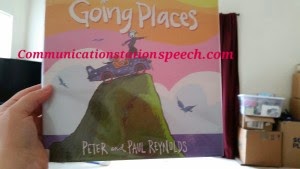
Tip Tuesday: Going Places (book review)


I found this book at our local library and read it to my son. I fell in love with it and found it to be a perfect book not just for my own child but also a great book for speech therapy for a number of reasons.

Firstly, the book is quite interesting for both boys and girls and it has great illustrations. But beyond the obvious I really like this book as a means to target social skills and higher level reasoning skills.


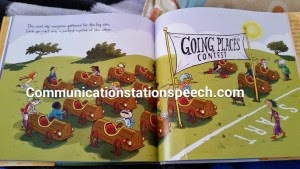
The book is about a boy who teams up with a classmate to make a special creation in order to enter into a race. The book encourages discussions about: teamwork, cooperation, compromise, personal inspiration, inventions and "outside of the box" thinking. The end of this book provides students with an opportunity to use context to predict what invention they will create next and through illustration only can a student determine if their "prediction" is correct. What a great way to work on predictions and inferences with our children with ASD!


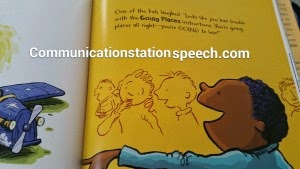
In addition, there is a moment when a fellow classmate criticizes the two main characters' creation. What a great opportunity to target social skills and talk about the ways in which we are different from each other and how we can accept others with our differences!

This is a simple book but one worth checking out at your local library.

Happy talking and reading!

post signature

Monday, May 25, 2015

Tip Monday: Finishing the Year Strong!


So today I'm linking up with The Frenzied SLPs page to discuss what get's us through the tough times of work!  I have a few tricks I use when times get tough to get me through the bad days and here they are (not in any particular order):

1. CHOCOLATE!: Yes, yes, I know you are saying "Duh!" but seriously, always have some types of sweets on hand for the stressful moments!  Take five and have a bite.  Let those endorphines release inside your brain to help take away some of that stress!

2. 5 mins of darkness: I have done this several times when I feel a stress migraine coming on.  I just close my laptop, turn off my light and shut my office door.  When it was really bad I used to lay on the floor b/c it's cooler on the floor and helps with the dizziness that accompanies my migraines.  If the door was shut, most people knew not to disturb!

3.  Christmas Music:  WHAT?  I know this sounds crazy, but Christmas carols just put me in a good mood. I've always LOVED the season and when all else failed, I'd pop in a trusty Christmas CD (that I keep on hand all year long for such occassions!), and play it loud enough just for me to enjoy!  It's reminds me of the time of year when people are generous, happy, understanding and compassionate to others.  I love it!  Christmas music not your thing? I understand.  Pick whatever CD or type of music you'd like.  Just remember to keep it on hand for these moments because sometimes a GREAT day turns badly very quickly when you have a terrible IEP or staff meeting!

4.  Pep talk: The last think I recommend doing is giving yourself a pep talk.  Keep nice parent notes or teacher emails handy and when you feel the world is pushing you down, read these things. Remember your toughest cases and how well they succeeded.  Remember why you are in this profession in the first place.  And always tell yourself, "you'll never have this day again".  How great does that feel to remember that you'll never have to go through the pain and stress of this day again? Or remember that this day isn't over and you can still do something to make it great!  Either way it's a win-win.

Good luck. I know the end of the school year is crunch time!  Just take a breath, grab some chocolate, hum a little bit of "Rockin' Around the Christmas Tree" (or your musical choice) and I'll see ya' on the other side!


post signature
Related Posts Plugin for WordPress, Blogger...