Friday, April 5, 2013

FREEBIE Friday: Rainy Day Boot Match-Up!

It's Spring and I think it's time for some cute spring speech and language freebies!  How about some a semantics game?

I made this Rainy Day synonym game for my language kids.  You can match up the synonyms, or have the students come up with their own.  There are also points cards in there (great for incorporating addition/subtraction to speech therapy).  Whomever has the most points at the end of the game, wins!


Grab your copy of Rainy Day Boot word match up here!


I also made a simple game board activity. You can work on associated words as well as categories with this simple game.


Grab your free copy of this game board here!


Enjoy and happy talking!!!

Wednesday, April 3, 2013

Wild Wednesday! ASD: Back OFF!!!

Years ago I was working my with a 4 year old diagnosed with ASD.  It was the first therapy day of the school year and I was working in a new school, so this was my first time meeting this little cutie.

With the early childhood teacher's cue, he walked over to me (looking every where else but at me), took my hand and walked down the hall to my therapy room.

"That wasn't too hard", I thought to myself.  I was, of course, quite pleased with how easily I was able to get this particular student, who was known for being quite difficult to handle, to "trust" me so quickly and follow my nonverbal lead.

We settled down at the table in the therapy room where I had several fun toys just waiting for us to explore and talk about.  My little buddy picked up a sensory spin toy and went to work filtering light out of the corners of his eyes.  I, in my infinite wisdom, decided I'd follow his lead by talking all about how that toy was spinning and lighting up.

After several minutes with my non-responsive pal, I was realizing all my "Ooos" and "Ahhhs" didn't seem to get a response so I decided to lean in closer and partake in the "filtering fun".  Unfortunately for me I moved in a bit too close and within milliseconds found my face connecting to his fist.  I was so shocked, I actually sat back and asked myself "Did this little guy just punch me in the eye?".  If I wasn't sitting  in front of a mirror and saw my red eye quickly beginning to swell, I'm not sure I would have believed it myself.  It was so quick and he didn't miss a beat.  He just kept playing with that spin toy and never said a word the entire session.

I actually started laughing out loud at myself.  After years of being a therapist, I made a rookie mistake and entered this child's personal space LONG before we had built a rapport.  So I decided from that moment on, I would shut up, give him space, and play "alongside" him (far out of his reach) until he was ready for me to enter his world.  And within a few weeks we were talking, playing, and yes I was even allowed to enter his personal space.

So the lesson I learned that day will stick with me forever.  Sometimes with students with ASD we don't know where their personal space bubble begins or ends.  It may be much bigger than we think.  The only thing we can do is BACK OFF until they let us know they feel safe...and always, always, keep these kids at least at arm's length!  Ha ha ha ha ha!

Happy Talking!

Tuesday, April 2, 2013

Tip Tuesday: ASD and DTT!

Chevron boarder:  http://coffeekidsandcompulsivelists.blogspot.com.au/
As April is Autism Awareness Month, I thought over the next four weeks, I would take time to write about one of things I LOVE about being an SLP, working with children with Autism Spectrum Disorders (ASD)!  I know many of you SLPs reading this out there are familiar with many of these topics.  However, as I have regular educators, parents and even grandparents who follow me, I will be discussing topics that not all readers may be familiar with.

In this post, I am writing under the assumption that those who are reading this understand what ASD is and what it looks like.  If you are not familiar with autism spectrum disorders, I encourage you to stop reading this right now and head on over to Autism Speaks and Autism Action Partnership for more information.  Then come on back and read about DTT!

Firstly, let me say that I do not believe that there is a "one size fits all" approach to treating children with ASD.  I believe there are a number of valid techniques that can work for children with ASD.  There are several factors that may affect your decision on which techniques to try:  1) severity of disorder and use of stimulatory behaviors, 2) sensory needs of the child, 3) family needs, 4) parental support, etc..  I tend to use evidence based practice (EBP) and trial and error to determine "what works" for each child on an individual basis.

Over the next five weeks we will be discussing topics such as discrete trial training (today), use of DTT principles with a penny board, DIR/Floortime/PLAY project principals, ABA vs. Son-Rise program and sensory diets. So...let's get started!!!!

What is DTT?

DTT or discrete trial training is a method of teaching small components/steps of a skills.  It is a method often used successfully when providing intervention to persons with ASD.  DTT is only one technique used in ABA (applied behavioral analysis) therapy.  DTT has an extensive body of research (website courtesy of Autism Speaks Blog) to support its use and success.

Word of Caution:  I would be remiss if I did not point out that upon review of research on past ABA studies, there have always been criticisms about the methodologies used in these studies and more recently, there are valid questions as to whether these research studies truly demonstrated the results they claimed.  In addition, the difficulty and/or lack of generalization of learned skills to more natural environments has always been a concern for those who question the use of ABA.  With that said there are thousands upon thousands of success stories (anecdotal research) of children who received ABA therapy and thousands of stories of children where ABA did not work.  So I just make these statements to let you know, there are children who can and have improved using these techniques and ones who haven't.  No one seems to know why some children respond to ABA techniques when others do no.  You as a professional or parent must conduct your own research and make your own decisions regarding the child's direction of therapy.

Want to read more about the critiques of ABA?  Check out:  A Case Study in the Misrepresentation of Applied Behavior Analysis in Autism: The Gernsbacher Lectures for more information and as always...you decide!

Ok now let's get down to talking about DTT!

What is a discrete trial?  One discrete trial consists of:
  • An SD: discriminative stimulus, otherwise known as the instruction (verbal, nonverbal-pointing/showing, physical-hand over hand, guide hand, etc.) given by the therapist to the child.  All SDs should be:
    • consistent and clear
    • free of extraneous information (includes visual, auditory, kinesthetic info, etc.)
    • slightly louder than normal speaking tone
  • Response or Prompt: Then the therapist waits for the child to respond, or provides help by prompting a response; follow hierarchy from MOST amount of scaffolding to least amount of scaffolding and must fade prompts (either by decreasing intensity of prompt or by checking to see if child is ready to move to next level of prompting); prompts include: 
    • physical-hand over hand, guide hand, etc., 
    • modeling,  
    • gestural-pointing, showing, 
    • positional-positing materials to encourage correct response, 
    • verbal-vocal cues to help child, 
    • echo prompts-you prompt verbal answer immediately after stimulus and have child echo 
  • Reinforcement or correction: Finally, (after the child's response), the child is given reinforcement for a correct response, or correction for an incorrect response.
    • reinforcement:
      • MUST be given immediately
      • IS GIVEN regardless of whether the child responded independently or with a prompt
      • should be exciting and motivating
      • should be varied (decreases boardem an sustains motivation)
    • What to do if the child responds incorrectly or not at all?  2 options:
      • Informational "No": say no in a neutral tone, exhibit stimulus again, provide model for correct response, when child imitates correct response, reinforcement follows.  OR
      • Errorless learning correction: the therapist does not say "no" but rather pauses (does not provide reinforcement), give stimulus again, immediately modeling correct response, after child gives correct response, reinforcement is given.
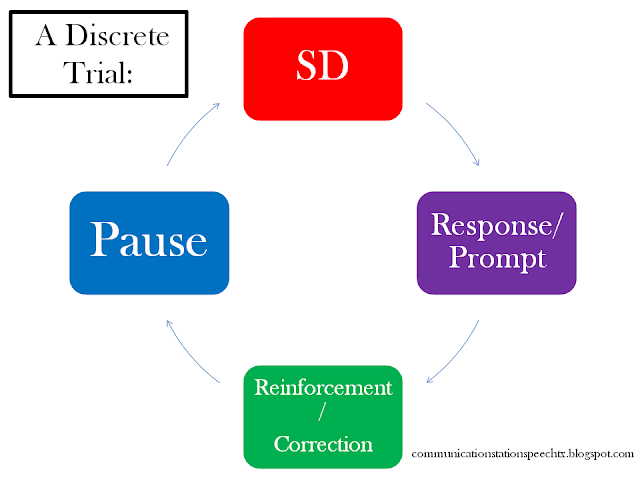
Want a copy of the above graphic for your reference?  You can download it here!

What is a reinforcer and how do I determine what to use as reinforcement?
A reinforcer is anything that is motivating to the child and signals to him/her that the response made was correct.  I like to take a preference inventory when I first meet new clients.  I ask the child's parents what types of toys, cartoon characters, snacks, physical touch, activities, praise, and sensory toys the child seems to enjoy.  This will provide me with a guide to determine possible reinforcers for each individual child.  

Tokens or counters can also be used for reinforcement.  Usually this technique is used only for children who are familiar with DTT for the purposes of delaying and fading out reinforcement (as child has to obtain several tokens/counters in order to obtain the reinforcer).

Note:  If the child has a sensory aversion to various textures, sounds, or visual stimuli, DO NOT use objects that exhibit those aversions as this will not be reinforcing for the child.

Positives to using DTT and/or ABA therapy: (overview-there are many more than listed here)

  • research shows consistent progress for various children
  • new skills can be taught in steps
  • undesireable behaviors are extinguished using negative consequences


Negatives to using DTT and/or ABA therapy: (overview-there are many more than listed here)

  • difficulty generalizing to other environments
  • reliance on cues and prompts
  • use of robotic speech
  • skills taught may not be functionally observed in the child's daily environment
  • negative consequences are viewed as harsh in nature

With such high caseloads,  is this really something an SLP can do in the school setting?
First off let me state that educators in the school environment are bound by FAPE (free and appropriate education) and are expected to provide services in the LRE (least restrictive environment) for EVERY student.  LRE means that the student should remain in the classroom setting as much as possible and only be removed when that skill/service etc. cannot effectively be taught/provided within that setting.  LRE can also be interpreted to mean that the amount of service a student receives outside of the classroom should be NO MORE than the amount the student requires to make progress (the amount of progress or speed of progress will vary on an individual basis depending on numerous factors: age, developmental level, cognition, co-morbid disorders, family support, etc.).  This is does not mean a student should spend the entire school day in a therapy room one-on-one with any therapist or special educator participating in hours of discrete trials.  If this is what you want as a parent, than you should think about seeking ABA therapy outside of the school day (keeping in mind that schools are not responsible for services outside of the school day).  In addition the goals targeted within the school environment MUST RELATE to the skills the child will need to successfully navigate within that academic environment.  That is the law.  Private practice/out-patient services can relate to services in the school environment but are bound by different regulations and laws which is why services in and outside of the academic environment look so different.  

So DTT cannot be done in the school setting?
With that said, as a school SLP it is quite tricky to say the least, to carve out time for one-on-one individualized sessions let alone hours of therapy.  However, for the appropriate students (the students low functioning where use of DTT principals was necessary to make progress), I could ONLY do this with the support and collaboration of the multidisciplinary members.  I worked closely with the child's special education teacher, classroom paraprofessionals, and occupational therapist.  And between all of us we were able to provide meaningful daily work periods of with some activities based on DTT principles for students (periods may only have been 15-30 mins depending on the students attention skills, cognition abilities, severity, etc.).  Of course this was not equivalent to the number of hours a child with ASD would receive via ABA therapy a week (although there is still some debate on the number of recommended hours of ABA therapy), nor should it be, based on federal law and LRE.  In addition, what tasks were taught were directly related to academic skills, behaviors, and curriculum.  Therefore with relatively fewer DTT principal based sessions/activities we as the multidisciplinary team, were able to teach skills AND encourage carryover into the classroom setting with fair consistency.

So I suppose my short answer is, DTT principals can be used to effectively teach children with ASD in various settings.  However the length of time and ability with which to provide DTT principal-based activities will change based on the setting we are providing these services (school, private practice, outpatient hospital, home, etc.).

The last thing we must remember is that ONLY TRAINED professionals should be providing ABA within their sessions.  As you can see above I do not claim to have provided ABA but rather, I have used DTT principles on which I have based my activities to support children as needed.  It is unethical to expect a professional untrained in this area to provide these services to your child.

Join me next week when I talk about how I use some of these principals in a modified activity with a penny board in order to teach academic skills/behaviors and how, as working with a team, we were able to generalize these skills to the classroom environment making a child with ASD more functional in nature.

Until then...happy talking!!!!


References:

Friday, March 29, 2013

FREEBIE Friday! Blue Car, Blue Car, What do you See?

 A few weeks ago a brilliant follower  on my FB page  (you know who you are) commented on a story about my son and she gave me a great idea!  Why not make a transportation themed book that imitates a much loved children's book that is repetitive and rhythmic in nature?  At that moment, Blue Car, Blue Car What Do You See? was formulating in my mind.  

Over the last few weeks, I've been able to purchase these very cute graphics from ReviDevi @ mygrafico.com and make this book for my PK kiddos.


And of course you know the rules here at C-Station:  if I make, you get it!  So here it is! 


Note that this booklet is made so you can either print it front to back (and fold) OR single pages (and cut down center line and place in order).  My personal preference is single pages (so you can only see the preview picture, not the next page) but if you need to save trees, you can do so by printing front to back and just folding the book!  It's really up to you! :)


I LOVE this book because of all the language skills I can work on:


  • concepts of transportation
  • color concepts
  • transportation sorting (land, air, water, or construction vs. rescue, etc.)
  • answering "What" and "Where" questions (e.g. What does a plane do?  Where do you see a plane?) 
  • similarities and differences between various types of transportation
  • making predictions with visual cues

At the bottom of each page is a small picture preview of what object is on the next page.  I made this book an interactive book by printing 2 copies of pages 1 and 2 and using the extra set of pictures with velcro to "match up" with the preview pictures on each page!


Above you see the second set of pages 1 and 2 cut and ready for the child to match up while using his/her visual cues to "predict" what we are going to "see" next!


We match it up (I like to use velcro but you don't have to) and turn the page to see if our prediction was correct!


Check out all of the pages!!!  Want your own copy?  Grab it at the bottom of this blog!


Error on this page above has been corrected in the download!


Want your FREE copy?  Grab it here!


Happy Talking!!!

Tuesday, March 26, 2013

Tip Tuesday! Ways to target categories for PK kiddos!


Last week I talked about the steps I use to teach PK kiddos how to understand analogies by focusing on understanding relationships between objects.  Today I'd like to just write the several ideas I have done with PK kiddos that have worked to teach them how to understand categories of objects!

If you have other ideas, PLEASE share by commenting below.  I know I can always use more ideas!!!!


There are some "rules" (for lack of a better word) I like to follow when teaching categories:

  1. Always begin with 2 MAXIMALLY different categories:  meaning I choose two general categories that have NOTHING in common (animals vs. clothing, OR furniture vs. musical instruments, etc.)
  2. Make categories as CONCRETE as possible:  meaning I use real objects as much as possible, followed by toys, than photographs, pictures, and cartoons (Microsoft clip art has tons of "cartoon" pics you can use); 
    1. NOTE: children who have speech and language deficits with NO OTHER cognitive delays or other co-morbid disorders do NOT require such and elaborate scaffolding system and can move very quickly from objects to pictures.  
    2. Children with OTHER cognitive delays or co-morbid disorders DO BENEFIT from this scaffolding system and in my clinical experience have been able to mastery understanding and verbal identification of categories with less difficulty using this system.
  3. Teach general categories FIRST followed by subcategories:  this means a child will demonstrate understanding of animals before I expect them to master "jungle, farm, ocean" animals; or a child will demonstrate understanding of food first before "fruit, vegetable, meat" subcategories.  I teach it this way b/c we know semantic learning is hierarchical in nature (general then subcategories, than sub-subcategories and so on) and we want our students to understand and organize their semantic relationships in a way that supports word retrieval and vocabulary development.  (Excuse the very crude visual below but this is just a quick display of the hierarchy of just one general category.  Clearly these sub-subcategories could continue and the number of items within them would number more than 3 animals.) 

Ok so those are the rules I like to follow when teaching categories.  Here are some activities I have done in the past to teach categories: (this list includes ONLY concrete sorting games as I think we are all familiar with file folder type sorting games)

Sorting for maximally different categories:
  • Using a big bowl and my Fisher Price farm-sorted food vs. animals
  • Using a box and a large serving plate-sorted musical instruments vs. food
  • Using a clothes line (yarn and clothes pins) and a doll house-sorted clothing vs. furniture
  • Using a box (labeled "Toy Box") and a book shelf-sorted toys vs. books
  • Felt board with volcano and felt board with sky on it-sorted $ store dinosaurs and sky transportation
  • using peers holding boxes (with picture labels on them)-sorted inside vs. outside items (then took outside times-pine cones, grass, flowers, acorns, leaves, etc. BACK outside)
  • Play stroller and clothes line-sorted baby items (baby food jars, rattles, bottles, diapers, etc.) and clothing on opposite sides of the room (when using maximal differences I do NOT add in baby clothing to this sorting activity)
Sorting subcategories:
  • Using a fish bowl and my Fisher price farm-sorted farm vs. ocean animals
  • Using legos (as our fences for a zoo or our jungle) and my farm-sorted zoo/jungle vs. farm animals
  • Using a fruit bowl and play refrigerator-sorted fruit vs. meat/vegetables/beverages
  • Using butcher paper, drew road, lake and sky-sorted land vs. sky vs. water transportation
  • Using a race track and water in my sensory table-sorted water vs. land transportation
  • Using my office desk and doll house-sorted school vs. home items
  • Using fire station and race track, with road signs and cones-sorted rescue vs. construction vehicles
  • While pretending to own book store-sorted books about animals and vehicles into 2 different boxes on either side of the room
  • While pretending to own restaurant sorted food categories in various places in my therapy room (refrigerator, table, microwave, fruit bowl, freezer, etc.)
  • Refrigerator and sink-sorted empty vs. full containers (empty goes in sink to be washed!)
  • Sorting by color and shape-using colored mats, colored cups, colored paper, colored egg cartons, etc.
  • Beach bag and box-sorted summer vs. winter clothing
  • Desk and kitchen-sorted writing vs. eating utensils 
  • Tons of sensory table play where we sort various subcategories of objects in play!
Well I think that is a pretty good start.  I know I've done so many more different types of sorting games with real objects and toys and as I remember more and more of them I will add them here!

What concrete sorting activities do your students like to do?

Happy Talking!

Sunday, March 24, 2013

SLP Link Up!

Oh, How Pintearesting! is having an SLP link up and I just love how you get to see some insights into what the SLP bloggers are up to right now!  Check out the rules by clicking the link above.


State of Mind:   Right now I am feeling Joyfully Blessed with all the time I am getting to spend with my husband and son recently.  The weather has been so nice here in southern AZ that we have been getting outside, playing, taking walks, hiking, and just having some good ol' fashioned family fun.  I don't think anything beats feeling that beautiful sunshine on my skin!  I am really hoping that Spring comes quickly to the rest of the US (especially those states that have been getting and expecting snow recently)!!!!

Loving:  I don't know about you but I ALWAYS LOVE Lent and the Easter Season!!!  It is my favorite time of year.  Firstly, it happens during my favorite season...YEP if you can't tell by now...I'm a Spring lover...bright happy colors, sunshine, flowers and trees blooming adds more hop in my step. :)  Secondly, I very much love the story of forgiveness, redemption and salvation that Easter brings to us every year!!!!  It's pumps me UP and gives me more hope in myself and in the human race.  We can be better people and every morning we wake up is a NEW DAY!  Yes...I am definitely a Spring lover!!! (Sorry groundhog, but you are outta here!)

Prepping:  As you all know by reading our speech blogs...we do what we do for the LOVE of the profession!  I LOVE being an SLP and I LOVE learning about new things.  I LOVE sharing information and I LOVE educating others on what we do and why what we do is important.  So of course, I am getting myself prepared for May's BSHM (for you non speechies out there...BSHM is Better Speech and Hearing Month for the American Speech-Language and Hearing Association)!  By the way, if you have any fantastically different or interesting ideas out there for BSHM...PLEASE don't hesitate to share below!

So that's what I'm up to!  Want to know what your favorite SLP bloggers are up to?  Head on over to Oh, How Pintearesting!  and check out their link ups at the bottom of the blog!

And as always...Happy talking!!!!


Friday, March 22, 2013

FREEBIE Friday: Artic Hidden Objects Easter Egg Hunt!

I made this simple activity to practice some articulation sounds in a fun way using the "idea" of going on a Easter egg hunt.

This packet has practice sheets for:
initial and final /K, G, S/ as well as /S, L, R/ blends.

What do you do?  Cut and laminate the eggs and place on top of the hidden objects.  As your students "find" the objects they will produce the object labels in words, phrases or sentences (which ever complexity you are working on).  You can also have one student "find" an object and describe (using attributes) to another student in order to connect articulation and language tasks.

Want to send these sheets home for homework?  Well you don't even need to use your color printer.  Just email the link to your student's parents and voila'...already made homework practice.

You've seen these eggs before you say?  That's right!  I made the puzzle match up last week using the same clip art from Clips by Jenn.  Check out what else she has at this link.

Grab your FREE copy of this packet here!


Enjoy and happy talking!!!
Related Posts Plugin for WordPress, Blogger...